GRE PSR-800 · Volume 5
GRE PSR-800 — Vol 5: Upgrades & Firmware
P25 EZ Scan handheld with the RadioReference library on microSD (2011)
5.1 About this volume
This volume covers the questions that decide whether a PSR-800 is still worth owning or buying: which firmware it needs, whether it decodes P25 Phase II, how DMR gets added, what it can never hear, and what to check on a used unit. The short answers:
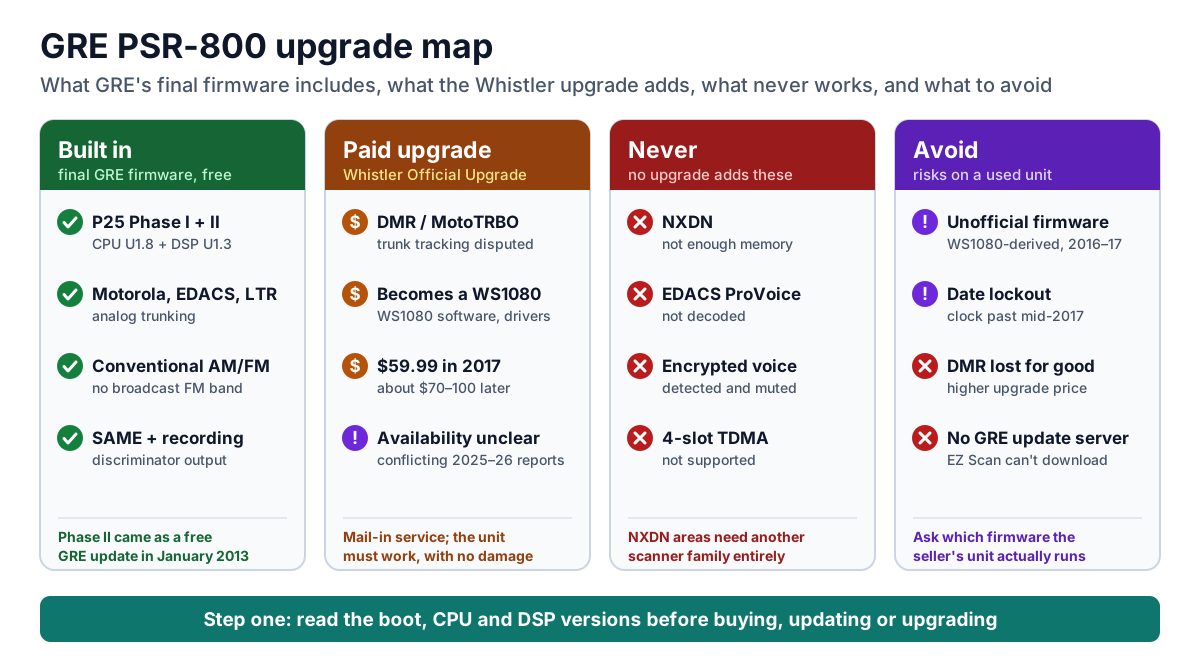
- P25 Phase II is already included, free, on GRE’s final firmware. The PSR-800 launched in 2011 as a Phase I scanner. GRE added Phase II with a free firmware update in January 2013 (CPU U1.8 with DSP U1.3). No paid upgrade is needed for Phase II.
- DMR comes only from the paid Whistler Official Upgrade (WOU). The upgrade converts the radio into a Whistler WS1080. Its availability in 2025–26 is uncertain, and reports conflict.
- NXDN, EDACS ProVoice, and encrypted voice are permanently out of reach. No firmware or upgrade adds them.
- GRE’s update servers are gone. GRE’s PC application still installs, but it can no longer download firmware or library updates. An unupgraded PSR-800 has no working official update path.
- Firmware state is the first thing to check on a used unit. A radio that has run unofficial WS1080-derived firmware may carry a date lockout, may have lost DMR capability for good, and costs more to upgrade.
Hardware, history, and the model family are in Vol 1. Operation, including Set Location and the attenuator, is in Vol 2. The PC application, Windows drivers, and microSD card preparation are in Vol 3. Specification and family tables are in Vol 4.
5.2 Start here: identify the firmware
Before buying, updating, or sending a PSR-800 for upgrade, establish what firmware it runs. The answer determines whether it decodes Phase II, whether it has been through the Whistler upgrade, and whether it carries unofficial firmware with a date lockout.
Three versions matter:
- Boot (loader) version. Holding MENU while powering on displays it, according to a 2026 owner report. A unit that shows boot 2.0 has been through the Whistler Official Upgrade and is now treated as a WS1080.
- CPU firmware. GRE’s Phase II release is U1.8. Anything earlier than U1.8 lacks the released Phase II support.
- DSP firmware. U1.8 requires DSP U1.3 or later. The CPU and DSP versions are designed to be paired.
GRE’s owner’s manual does not document an on-screen firmware-version display, and the exact menu path for reading CPU and DSP versions on the radio could not be confirmed from the manual. When buying remotely, a seller can be asked for a photo of the power-on screen, or a screenshot of the PC application connected to the radio.
What the versions mean:
Table 1 — What the versions mean:
| Reading | What the unit is |
|---|---|
| CPU below U1.8 | Original GRE firmware without released Phase II. Phase II firmware is no longer officially downloadable (see Updating the firmware). |
| CPU U1.8 or later, DSP U1.3 or later | GRE’s Phase II firmware. This is the best state an unupgraded PSR-800 reaches. |
| Boot 2.0 | Whistler Official Upgrade applied; a WS1080 in software terms, with DMR. |
| CPU 3.x or DSP 3.1–4.6 on a PSR-800 | Almost certainly unofficial WS1080-derived firmware. See Unofficial firmware and the date lockout. |
5.3 Firmware history
GRE shipped separate CPU and DSP firmware for the PSR-800, and the two were updated independently. The history below is assembled from GRE’s press releases, GRE’s release notes as posted to RadioReference, and forum reports; confidence varies by line.
Table 2 — Firmware history
| Version | Date | What changed | Confidence |
|---|---|---|---|
| Launch firmware | February 2011 | P25 Phase I, Motorola, EDACS, and LTR trunking; programming by browsing the Library. The version number is not documented. | Confirmed (capabilities) |
| CPU 1.5 | 2012-01-11 | Set Location: programming by ZIP code, city, or county instead of browsing the Library (Vol 2) | Confirmed (GRE press release) |
| CPU U1.7 beta + DSP U1.2 | mid-October 2012 | Experimental P25 Phase II, released as a standalone updater. 4-slot TDMA voice not supported; radio IDs not shown on Phase II voice channels. GRE described it as PSR-800-only. | Confirmed |
| DSP U1.3 | 2012–13 | Required by CPU U1.8 | Confirmed |
| CPU U1.8 | 2013-01-15 | Phase II released: Phase II talkgroups display “D2” instead of “DG”; radio ID decoding; priority channel detection; fixes a beta bug in which the radio failed to return to the control channel. Requires DSP U1.3 or later; delivered with PC application 1.08 build 286. | Confirmed |
| CPU U1.9 | not established | Reported as a minor EDACS fix | Unconfirmed (forum) |
| CPU 2.0 | posted 2015-06-04 | Audio Boost handling fixed for analog frequencies; EDACS ESK detection fixes. Delivered only through the PC application. | Version and date likely; publisher unconfirmed |
Two cautions apply to the later lines. GRE shut down scanner manufacturing in the autumn of 2012 and GRE America closed its US office in September 2014, so CPU 2.0 appeared after GRE America had closed; who published it is not established, and forum discussion questions whether it is a genuine GRE release. And the official PC application offers no downgrade path: once U1.8 is installed through it, there is no official way back. The community GREFwTool (below) can downgrade, outside any manufacturer support.
GRE’s Phase II beta arrived at an unusual moment. GRE had already shut down manufacturing, and for a period the PSR-800 was the only handheld on the market that followed Phase II systems. Used prices briefly rose well above the original list price as a result (Vol 1).
5.4 What the PSR-800 can and cannot decode
Table 3 — What the PSR-800 can and cannot decode
| Capability | PSR-800 on final GRE firmware | RadioShack PRO-18 (GRE-built) | After the Whistler Official Upgrade |
|---|---|---|---|
| Conventional AM, FM, narrow FM; CTCSS/DCS | Yes | Yes | Yes |
| Broadcast FM (wideband FM, 88–108 MHz) | No; the band is not covered | No | No |
| P25 Phase I: conventional and trunked | Yes | Yes | Yes |
| P25 Phase II (2-slot TDMA) | Yes, free since CPU U1.8 | No | Yes (the PRO-18 gains it) |
| Motorola X2-TDMA | Likely: credited by the RadioReference wiki, not in GRE’s release notes | No | Likely |
| Motorola Type I/II, SmartNet/SmartZone | Yes | Yes | Yes |
| EDACS wide/narrow (analog voice) | Yes | Yes | Yes |
| LTR | Yes | Yes | Yes |
| DMR / MotoTRBO | No | No | Yes; trunked DMR followed by scanning site frequencies (see below) |
| NXDN | No, and no upgrade exists | No | No |
| EDACS ProVoice | No | No | No |
| Encrypted voice (any algorithm) | Detected and muted | Detected and muted | Detected and muted |
| 4-slot TDMA voice | No | No | No |
| D-STAR, Yaesu Fusion, dPMR | No | No | No |
The PRO-18 is the cut-down twin. GRE built it for RadioShack in 2011 with a different faceplate and loader. Besides lacking Phase II and X2-TDMA, it has no audio recording, no discriminator output, no tri-color alert LED, and 100 scanlists instead of 200. The Whistler upgrade adds Phase II to a PRO-18; on a PSR-800 the upgrade matters only for DMR. The later RadioShack PRO-668 is a different radio: Whistler built it in 2015 as a relabelled WS1080 (Vol 1).
5.5 What the PSR-800 can’t hear
Most of the PSR-800’s gaps are permanent. One, DMR, can be closed only by the paid Whistler upgrade.
Silent on a PSR-800 unless it has been through the Whistler upgrade:
- DMR / MotoTRBO: common on school, utility, business, and some county and fire systems.
Silent on the PSR-800 platform permanently:
- NXDN, used by some utilities, railroads, and county systems. Whistler added NXDN only in its redesigned TRX line, which has more memory than the WS1080-class hardware.
- EDACS ProVoice. The PSR-800 follows EDACS systems but cannot decode ProVoice voice.
- 4-slot TDMA voice. GRE’s Phase II beta notes excluded it; the U1.8 release summary does not restate the limitation, and no later source says it was added.
- P25 Phase II on a PSR-800 still running firmware older than U1.8. This one is fixable, but only with firmware that is no longer officially downloadable.
Silent on every scanner, the PSR-800 included:
- Encrypted voice of any kind, whether P25, DMR, or another mode, and whether the encryption is AES, DES, or Motorola ADP. The PSR-800 detects encryption from the clear-text signalling and mutes the audio. Decrypting it would be unlawful; the Decrypting dive explains why. Owners run into this more than anything else on the list, because many agencies encrypt tactical, investigative, and sometimes all dispatch talkgroups.
- OpenSky (M/A-COM/Harris), a proprietary protocol that no scanner has ever been able to monitor.
- TETRA, which is not used for US public safety.
- Analog voice scrambling, such as voice inversion or rolling-code scramblers.
- Push-to-talk over cellular (LTE), including FirstNet push-to-talk apps, Motorola WAVE, and Harris BeOn. This travels as cellular data, not radio voice a scanner can receive.
- Anything outside the PSR-800’s frequency coverage. The radio tunes 25–54, 108–174, 216–512, 764–782, 791–797, 806–824, 849–869, 894–960, and 1240–1300 MHz. There is nothing between 54 and 108 MHz (so no FM broadcast), nothing between 174 and 216 MHz, the cellular blocks are excluded by law, and nothing above 1300 MHz is covered. (Universal Radio’s listing gives the 791 MHz segment as 791–798.99 MHz, a minor conflict with GRE’s manual.)
Harder, but not silent: the PSR-800 family is sensitive but can be overloaded by strong nearby transmitters. The attenuator (Vol 2) helps; it does not cure a front end that the later TRX line reportedly improved.
How to check an area. Look up each system of interest on RadioReference:
Table 4 — How to check an area. Look up each system of interest on [RadioReference](https://www.radioreference.com)
| System shows… | PSR-800 (U1.8) | PSR-800 after Whistler upgrade |
|---|---|---|
| Project 25 Phase I or Phase II, Motorola analog, EDACS (analog voice), LTR, conventional | Hears it | Hears it |
| DMR, including Capacity Plus or Connect Plus | Silent | Decodes; trunked systems followed by scanning site frequencies |
| NXDN or EDACS ProVoice | Silent (no upgrade exists) | Silent (no upgrade exists) |
| Encrypted talkgroups (a mode ending in E, such as DE or TE), or an OpenSky system | Silent on any scanner | Silent on any scanner |
The PSR-800’s on-card Library describes what is on the air, not what the radio can decode. A system appearing after Set Location does not mean its voice traffic will be heard.
5.6 Updating the firmware
5.6.1 The official procedure, now historical
The PC application updated the radio over USB. With the scanner powered off and connected (the microSD card mounts as a drive), the procedure was:
- Close any autorun window and open the PC application’s Update menu.
- Choose Check for CPU Firmware Update, then Check for Updates, then Update My Scanner, and wait several minutes for Done.
- Repeat with Check for DSP Firmware Update.
If an update failed, the radio could be forced into CPU update mode by holding MENU while plugging in the USB cable, and the update retried. This procedure is documented in the Whistler WS1080 manual and matches the GRE application from version 1.8 onward.
It no longer works for an unupgraded PSR-800. GRE’s servers are gone, so the GRE application’s update checks find nothing. The application still installs and still programs the radio and prepares cards (Vol 3), but neither firmware nor Library updates can be downloaded through it. No manufacturer currently distributes PSR-800 firmware files.
The Whistler/Goliad downloads page is not a substitute. It lists only WS1080 files: EZ-Scan for WS1080 v2.51.0.707, CPU Updater WS1080 U4.8, and a U4.8 BOOT2.0 variant. Whistler’s FAQ states that officially upgraded units are treated as WS1080s but use a separate CPU loader; matching that to the BOOT2.0 updater is an inference, not documented. These files are for WS1080s and upgraded units. Running a WS1080 CPU update on an unupgraded PSR-800 is exactly the mismatch the community tool warns against, below.
Before any update, the manual’s card-safety rules apply: power off before connecting or disconnecting external power, and eject the card drive before unplugging, or the microSD card can corrupt. Save the configuration to the PC first (Vol 3).
5.6.2 GREFwTool: the community path
GREFwTool is a GPL-3.0 Windows utility, maintained on GitHub by philcovington as a fork of an abandoned original. It updates, downgrades, and “regresses” CPU and DSP firmware and sets the clock on the PSR-800, PRO-18, PRO-668, and WS1080. It also offers an experimental transcode that runs one model’s firmware on another.
It is unofficial, and its own documentation carries the warnings:
- Enter CPU update mode by holding MENU while plugging in USB.
- Do not use “CPU Update” in the PC application with mismatched firmware. The bootloader erases the radio’s application firmware, leaving a radio that will not start until correct firmware is loaded.
- Cross-model firmware on a PSR-800 requires in-radio charging to be disabled.
- Cross-model firmware voids manufacturer support. Whistler charges more to upgrade units that have run unofficial firmware and warns that DMR can be permanently disabled on them (see Unofficial firmware and the date lockout).
GREFwTool does not supply firmware. The files have to come from owners’ archives, and RadioReference threads asking for PSR-800 firmware archives show how scarce they have become. For a PSR-800 already on U1.8 and DSP U1.3, there is little to gain from it.
5.7 The Whistler Official Upgrade
After Whistler acquired GRE’s scanner technical assets in late 2013, it built the WS1080: operationally the same radio as the PSR-800, with a few obsolete parts replaced. In 2017 it opened a mail-in service that converts GRE-era units into WS1080s.
What it does. Whistler applies a new bootloader and WS1080-level firmware. The unit afterwards counts as a WS1080 and gains:
- DMR / MotoTRBO decoding. Whistler’s 2017 announcement lists conventional DMR, MotoTRBO Capacity Plus, Connect Plus, and Linked Capacity Plus, and Hytera XPT.
- P25 Phase II, on the PRO-18 only. A PSR-800 already has it from GRE’s firmware.
- The WS1080’s other firmware fixes.
How DMR trunking works on this platform. Whistler’s announcement lists the trunked MotoTRBO systems, while the RadioReference wiki pages for the PRO-18, PRO-668 and WS1080 say the platform decodes DMR voice but cannot trunk-track it (attributing this to unpaid licensing, a claim with no primary source). Whistler’s TRX-1 user guide reconciles the two: for DMR and NXDN the scanner does not use the control channel; it scans every frequency of a site and matches talkgroups. Trunked DMR systems are therefore followed, but not in the control-channel sense that P25, Motorola, EDACS and LTR are, and calls can be missed on a busy site. Owners on Capacity Plus or Connect Plus systems should treat trunk tracking as unproven. The site-scanning method is described in Whistler WS1080 / WS1088 — Vol 2.
Price history:
Table 5 — Price history:
| When | Price | Notes |
|---|---|---|
| June 2017 (launch) | $59.99 | Owner pays inbound shipping; Whistler pays return. About two weeks. The unit must work and have no visible damage. |
| Nov 2023 – Jan 2024 | $69.99 | Units on correct model firmware; four to six weeks |
| Nov 2023 – Jan 2024 | $99.99 | Units that have run unofficial firmware |
| Nov 2023 – Jan 2024 | $129.99 | With possible cosmetic repair |
| August 2026 | about $100 (one owner’s quote) | Status disputed; see below |
Availability in 2025–26 is uncertain. Whistler went out of business in 2024, and Goliad Products, LLC bought its assets in January 2025. Whistler support said in April 2025 that the legacy upgrade would return in May 2025; it was still not available in July 2025. In June 2026 owners were directed to [email protected]. Reports since then conflict: one owner was told in July 2026 that the upgrade is no longer offered, another was quoted about $100 in August 2026, and others report slow or no responses. Current terms and the shipping address should be confirmed by email before sending a radio; the pre-Goliad repair address in older forum posts may no longer apply. The upgrade as seen from the WS1080 side, including what it adds to the PRO-18 and PRO-668, is in Whistler WS1080 / WS1088 — Vol 4; the Goliad takeover is traced in Whistler TRX-1 / TRX-2 — Vol 4.
After the upgrade, use WS1080 software. An upgraded unit needs the WS1080 driver and WS1080 EZ Scan, not GRE’s. A June 2026 owner with a freshly upgraded PSR-800 saw “no removable drives found” until switching to WS1080 EZ Scan.
Library updates are the other reason to upgrade. WS1080 EZ Scan is the only official route to fresh RadioReference Library data. Those updates stopped at Library v894 in November 2024 when Whistler closed. Goliad announced on 2025-03-06 that EZ Scan updates were available again, and an owner confirmed in July 2025 that they worked. No post supporting a reported 2026 loss of RadioReference data could be traced; the likely source is a one-day update-server outage on 2026-06-23/24, after which Whistler’s support account reported a server upgrade and updates resumed. A forum workaround of copying Whistler Library files into GRE’s application is undocumented by any manufacturer.
5.8 Unofficial firmware and the date lockout
Around 2016–17, unofficial firmware derived from the WS1080 circulated on RadioReference as a way to add DMR to the PSR-800 and PRO-668. It worked for a time, and it left a trap in the used market.
The date lockout. Two accounts describe it, and they disagree on the details:
- The RadioReference GRE/RS PC Object Oriented FAQ says units running DSP 4.6 with CPU 3.1 must not have their clock set past 2017-05-31, manually or through the PC application’s option to set the clock to computer time. Past that date the scanner locks and DMR decoding is cancelled.
- A 2017 forum thread describes a time bomb in a late-June DSP 3.1 build, triggered by dates after 2017-07-01, leaving units semi-bricked at a “Waiting for USB” screen.
Every present-day date is past both triggers. The PSR-800’s clock is also lost if the batteries are out for more than a few minutes, per GRE’s manual, so a unit on this firmware is exposed whenever its clock is set.
The consequences.
- Whistler repaired affected units for $89, a figure reported in 2017 covering a chip replacement plus the official upgrade.
- Whistler charges more to upgrade units that have run unofficial firmware: $99.99 instead of $69.99 in 2023–24.
- Whistler warns that DMR can be permanently disabled on such units, with the loader, CPU, and DSP locked.
A seller’s description of a unit as “upgraded to DMR” does not distinguish the official Whistler upgrade (boot 2.0) from unofficial firmware. The distinction is worth tens of dollars and possibly the DMR capability itself.
5.9 Buying a used PSR-800
Checklist:
- Firmware state. Read the boot, CPU, and DSP versions (Start here). Boot 2.0 means the official upgrade. CPU U1.8 or later with DSP U1.3 means GRE’s Phase II firmware. CPU 3.x or DSP 3.1–4.6 means unofficial firmware and the date-lockout risk.
- DMR. Only upgraded (or unofficially flashed) units decode DMR. A plain PSR-800 is P25 Phase I/II plus analog trunking.
- Update path. An unupgraded PSR-800 has no working official firmware or Library updates. If current Library data or DMR matters, budget for the Whistler upgrade, and allow for the possibility that it is unavailable.
- microSD card. Confirm the card is present and the radio boots without an 03-xx (card) or 05-xx (configuration file) error. Otherwise plan a card rebuild with the PC application (Vol 3). Some microSD brands are reported to fail with Error 03-01.
- USB mini-B jack. It is both the data port and the power and charging input. Check that the card mounts on a PC with the radio off, and that the battery icon animates when charging.
- Battery compartment. Check the door latch, look for corrosion, and confirm the ALK/NiMH switch is set to match the cells. Alkaline cells must never be run with the switch at NiMH.
- Controls and display. Check the BNC connector, the squelch knob, keypad backlighting, the 132 × 65 dot LCD for missing rows, and the tri-color alert LED (absent on a PRO-18).
- Software. GRE’s PC application needs the unsigned-driver procedure on Windows 10 (Vol 3); an upgraded unit needs WS1080 software and drivers instead.
- Squelch behaviour. A RadioReference thread title reports a weak-signal squelch problem across the PRO-668, PSR-800, and WS1080; the thread was not read, so this is unconfirmed.
Price data is weak.
- At launch: MSRP was reportedly $499, with 2011 street prices of about $400–440.
- 2012–14: during the gap when it was the only Phase II handheld, used prices reportedly reached $600–700 (unconfirmed).
- 2015: used units were down to about $150–200.
- 2025–26: one eBay listing was seen at $179.99, and an undated eHam listing offered a new-old-stock PRO-668 at $230. Completed-sale prices could not be measured.
A rough, unmeasured estimate puts an unupgraded PSR-800 around $100–180, with an officially upgraded unit that includes its card, cable, and manual at the upper end or above.
When another scanner is the better buy:
- DMR is needed and the Whistler upgrade is uncertain: a Whistler WS1080 or WS1088 has DMR from the factory on the same platform (the WS1088 adds a numeric keypad), and WS1080 software remains on Whistler’s downloads page.
- NXDN is needed: only Whistler’s redesigned TRX-1/TRX-2 in this lineage handles it (still sold new in 2026 at $599.99 and $679.99; launch prices were reported between $539.95 and $729.95 depending on source and model). Better front-end filtering is claimed for them but unconfirmed. See the Whistler TRX-1 / TRX-2 dive.
- Current database support, ProVoice, or long-term manufacturer backing matter: a Uniden SDS100 or SDS200 has Phase II built in and DMR, NXDN, and ProVoice as paid keys, with free weekly database updates. See the SDS100 Upgrades & Firmware and BCD536HP Upgrades & Firmware volumes.
5.10 Downloads and manuals
Manuals in this site’s Reference Library:
Table 6 — Manuals in this site's Reference Library
| Document | Covers |
|---|---|
| GRE PSR-800 EZ Scan-SD Digital Scanner — Owner’s Manual | GRE’s 90-page 2011 manual, as filed with the FCC (FCC ID ADV0602902): controls, Library and scanlists, V-Scanner II, recording, SAME weather, discriminator output, troubleshooting, and specifications. It predates firmware 1.5 and does not describe Set Location or Phase II. |
All PSR-800 documents in one list: Reference Library — PSR-800.
Software and support pages
- Whistler (Goliad Products) downloads: WS1080 EZ Scan and CPU updaters only; nothing for the PSR-800, PRO-18, or PRO-668
- Whistler FAQ: unsigned-driver steps and SD card preparation
- GREFwTool: community firmware tool (GPL-3.0; unofficial)
- RadioReference wiki — PSR-800 and GRE PSR-800 based scanners: model family and capabilities
- RadioReference wiki — Whistler Official Upgrade (WOU): upgrade terms and pricing history
- RadioReference wiki — Windows 10 installation of GRE PSR-800 software and driver
- RadioReference wiki — PSR-800, PRO-668 and WS1080 error codes
- RadioReference wiki — Whistler EZ Scan FAQ
- RadioReference: look up which systems an area uses
Sources
- GRE America, GRECOM PSR-800 EZ Scan-SD Digital Handheld Scanning Receiver Owner’s Manual (2011), FCC ID ADV0602902 exhibit: features, card-safety warnings, clock, encryption detection, supported modes, and specifications.
- GRE press releases: GRE Introduces Next Generation Digital P25 Scanning Receiver (2011-01-06); GRE Releases Major Firmware Update for GRECOM PSR-800 (2012-01-11, firmware 1.5).
- RadioReference forums: P25 Phase 2 firmware update for PSR-800 (U1.7 beta); PSR-800 firmware U1.8; CPU firmware 2.0 update is available; Anyone with PSR-800 firmware archives; Updating to Phase 2 firmware; Official DMR upgrade for PRO-18 and PRO-668 by Whistler; Upgrade PSR800; Need unofficial DMR files for my PSR-800; PSR-800 upgrade information; Trouble with EZ Scan; Update from Whistler / Goliad Products LLC, March 6 2025; EZScan library updates; Legacy upgrade; Trouble updating DSP and firmware for a GRE800 that’s now a WS1080; How much should a GRE PSR-800 cost.
- RadioReference wiki: PSR-800, GRE PSR-800 based scanners, Pro-18, Pro-668, WS1080, Whistler Official Upgrade (WOU), GRE/RS PC Object Oriented FAQ, Whistler EZ Scan FAQ, error codes.
- Whistler: Whistler to offer upgrade to legacy radio scanners (2017-05-19); Whistler history; new ownership press release; downloads; FAQ.
- Whistler WS1080/WS1088 user manual (ManualsLib): firmware and Library update procedure.
- GREFwTool README.
- Scanner Master: Firmware alert: GRE PSR-800; Limited stock on GRE PSR-800; Whistler TRX-1/TRX-2 review.
- Universal Radio: GRE PSR-800 (coverage listing).
- RadioReference wiki: OpenSky, Trunked Radio Systems.
Comments (0)