Decrypting — AES, DES & Motorola ADP on P25 (Scanners) · Volume 1
Decrypting — Vol 1: How Radio Encryption Works, and the Legal Line
What P25 hides, what it leaves in the clear, and where the law draws the line
1.1 About this volume
Every consumer scanner does the same thing when it lands on an encrypted talkgroup: it flashes ENC and goes silent. That behaviour prompts more questions than almost anything else on the bands — what the radio is doing, why the traffic can’t be heard, and, always, the follow-up: can’t it just be decoded with a computer? This dive is the long answer. It lays out how radio encryption actually works, how a radio turns ciphertext back into speech when it holds the key, what the security researchers found when they took P25 apart, and what pointing a software-defined radio at an encrypted system really does.
Two things are worth stating plainly at the outset. First, the honest technical picture is less exciting than the forums make it sound. Modern public-safety encryption — AES-256 — has no practical break. The real-world “successes” people trade stories about were failures of configuration and of old, weak algorithms, not somebody cracking AES on a laptop. Second, the legal line is real, and it stays in view the whole way through: listening to unencrypted public-safety traffic is lawful, but decrypting communications one is not authorized to hear is unlawful, even passively. So this dive explains how the technology works and what the research showed. It is not a how-to for intercepting anything, and nothing in it turns an SDS100 — or an SDR — into a way to hear a locked-out local system.
With that said, encryption is genuinely interesting engineering, and understanding it changes how a scanner’s display reads. Once it is clear what rides in the clear on an “encrypted” system, that little ENC icon says a lot more than “no audio.”
1.2 What encryption actually hides
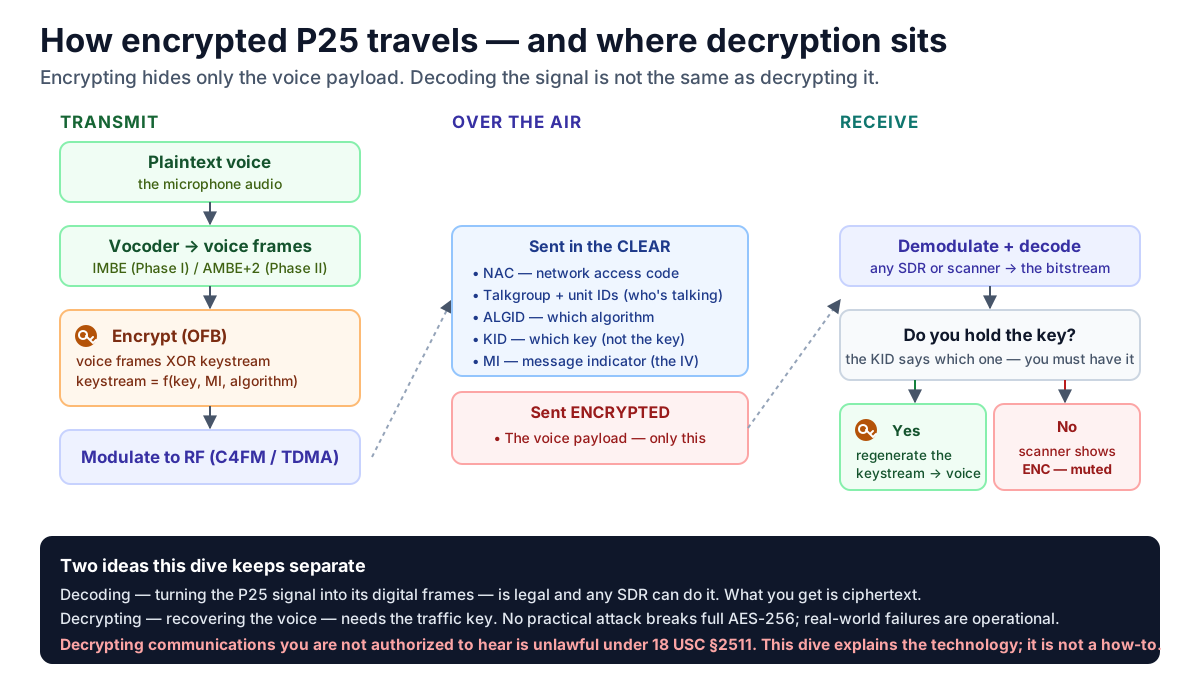
The single most useful thing to understand about P25 encryption is how little of the transmission it covers. It encrypts the voice payload — the digitized speech frames, and nothing else. Everything the network needs to route the call, and everything a receiver needs to know before it can even attempt to decrypt, is sent in the clear, on every transmission, encrypted system or not:
- the NAC (Network Access Code), the 12-bit “color code” that prefixes every P25 packet;
- the talkgroup ID and the source and destination unit IDs — who is talking, to whom, on which talkgroup;
- the ALGID (Algorithm ID), naming which cipher is in use;
- the KID (Key ID), naming which key to use — but never the key itself;
- the Message Indicator (MI), the per-transmission value that seeds the keystream.
The reason it works this way is practical. A trunked system has to route the call before anyone can decrypt it, and a receiver has to know the algorithm and which key to load before it can turn ciphertext into audio. A radio that tunes to a call already in progress has to re-synchronize mid-stream, so the MI is re-sent several times a second. All of that has to be readable without a key, so all of it is unencrypted.
The consequence is worth sitting with: a fully encrypted P25 system still leaks, continuously, who is talking to whom, on which talkgroup, with which key. The voice is unrecoverable without the key, but the traffic pattern is wide open. Watching an encrypted system on a capable decoder yields not a word of voice, yet units can be seen keying up, busy talkgroups stand out during an incident, and the key IDs are readable. That is called traffic analysis, and P25 hands it over for free. It matters later, in the security-research volume, because some of the most useful “attacks” on P25 never touched the crypto at all — they lived entirely in this clear metadata.
How the voice itself gets hidden — the keystream, the XOR, the output-feedback mode, the algorithms behind the ALGID values — is the whole of Vol 2. Here only the shape matters: encryption is a thin layer wrapped around the voice, riding inside a packet whose address label is written in plain sight.
1.3 The legal line, up front
None of this is legal advice, but the framework is clear enough to state with confidence. The relevant federal law is the Electronic Communications Privacy Act, at 18 U.S.C. §2511. It generally prohibits intentionally intercepting electronic communications, but it carves out an exception, at §2511(2)(g)(i), for radio communications “readily accessible to the general public.” Ordinary unencrypted public-safety voice falls inside that exception — which is the statutory reason it is broadly lawful to listen to local police, fire, and EMS when they are in the clear.
The catch is how “readily accessible to the general public” is defined. 18 U.S.C. §2510(16) spells it out, and it specifically excludes any radio communication that is “scrambled or encrypted.” So encrypted traffic is, by the statute’s own definition, not readily accessible to the general public — which means intercepting and decrypting it is not covered by the exception that makes scanning legal. That is the whole legal distinction in one sentence: the same law that makes it fine to listen to the clear channel makes it not-fine to break into the encrypted one. On top of that, cellular is separately blocked, divulging or using intercepted content can carry its own liability, and a number of states restrict scanner use (in a vehicle, or in the commission of a crime) even where listening at home is fine.
There is a real and reasonable public argument underneath all of this — taxpayers fund these agencies, so why can they lock the public out? That is a genuine policy debate, with active legislation and press-freedom advocacy behind it, and it is important enough to have its own volume at the end of this dive. But the debate is about what the law should be. The law as it is draws the line at encryption, and this dive respects that line: it explains the mechanism and does not cross it.
1.4 What a scanner does, and what it can’t
When a Uniden SDS100/SDS200 or a BCD536HP — or a Whistler, for that matter — meets an encrypted talkgroup, it detects the encryption from that clear metadata, displays ENC, and mutes. There is no menu to type a key into, because these scanners have no key store and no key-loading capability at all. They are receive-only appliances that were never built to hold cryptographic keys.
This is the place to head off the most common confusion on the subject. The paid DMR, NXDN, and ProVoice keys sold for the SDS and BCD-HP scanners (covered in each device’s Upgrades & Firmware volume) are not decryption keys. They unlock digital modes — the ability to decode unencrypted DMR, NXDN, or EDACS ProVoice voice. They have nothing to do with encryption. A DMR talkgroup can be in the clear (the mode key decodes it) or encrypted (the scanner still shows ENC and mutes, key or no key). “Unlocking a mode” and “decrypting a signal” are different operations, and no consumer scanner does the second one. Where applying a key even becomes technically possible is the SDR-and-OP25 story in Vol 5 — and even there, the key has to be one already, lawfully, held.
1.5 How the rest of this dive is organized
- Vol 2 — The algorithms. DES, Triple-DES, AES-256, and Motorola’s ADP, from weakest to strongest, with the ALGID values, the output-feedback keystream, and the Message Indicator.
- Vol 3 — How a radio decrypts. Keyloading with a KVL, over-the-air rekeying, the TEK/KEK hierarchy, and the receive pipeline that turns ciphertext back into voice — and why a scanner sits permanently on the “no key” branch.
- Vol 4 — The security research. The Blaze/Clark USENIX work and what it actually found: traffic sent in the clear by mistake, metadata leakage, cheap jamming — and, notably, no break of AES.
- Vol 5 — Capturing the signal. The old discriminator tap, the modern SDR, OP25 and DSD+, and the hard wall between decoding a signal and decrypting it.
- Vol 6 — The law and the public-access debate. Why listening is legal, why agencies may encrypt, and the transparency fight over what taxpayers are entitled to hear.
Sources
- 18 U.S.C. §2511 (ECPA) — Cornell Legal Information Institute: https://www.law.cornell.edu/uscode/text/18/2511
- 18 U.S.C. §2510(16), definition of “readily accessible to the general public”: https://www.law.cornell.edu/uscode/text/18/2510
- Project 25 (P25) — Wikipedia (encryption overview, clear metadata, vocoders): https://en.wikipedia.org/wiki/Project_25
- L3Harris, Project 25 Encryption white paper (what is encrypted vs. clear; OFB over the vocoder): https://www.l3harris.com/sites/default/files/2023-03/cs-pspc-project-25-encryption-whitepaper.pdf
- Matt Blaze, P25 security research portal (context for the metadata-leak point, expanded in Vol 4): https://www.mattblaze.org/p25/
Comments (0)