Whistler WS1080 / WS1088 · Volume 1
Whistler WS1080 / WS1088 — Vol 1: Introduction & Hardware
The GRE PSR-800 platform under the Whistler badge, and the PRO-668 and upgraded units that share it
1.1 About this volume
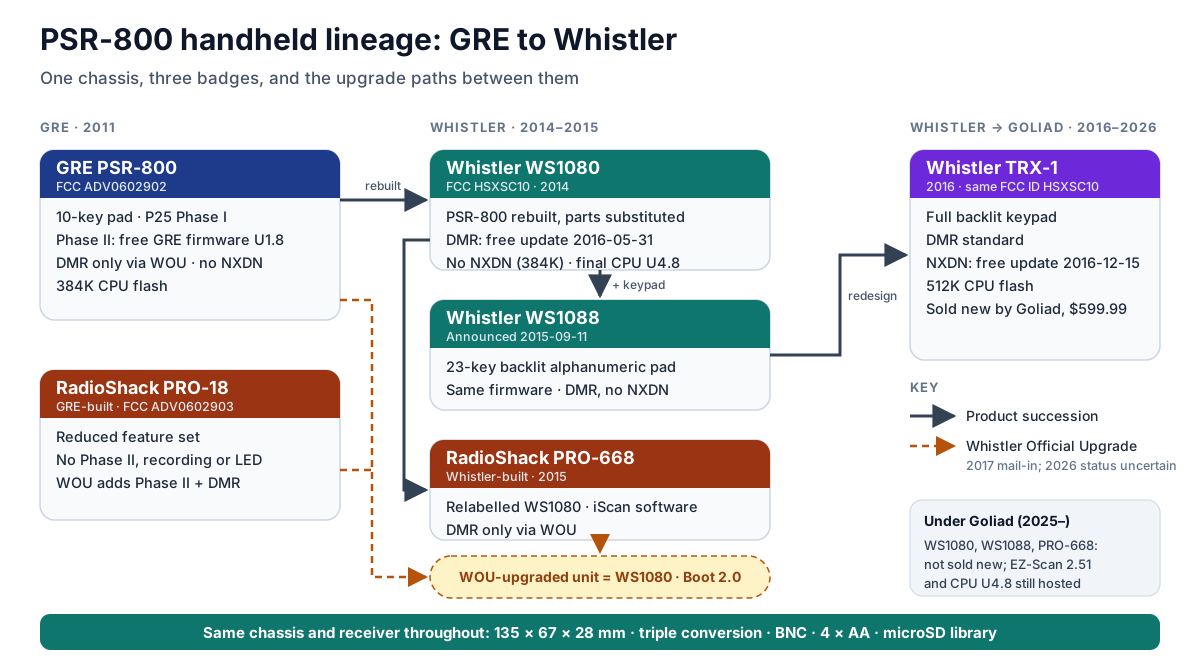
The Whistler WS1080 and WS1088 are the second life of the GRE PSR-800. When GRE left the scanner business in 2012, its handheld was the most capable library-programmed scanner on the market and the first to decode P25 Phase II; the design did not die with the company. Whistler bought GRE’s scanner technical assets, put the PSR-800 back into production under its own name as the WS1080, added a full alphanumeric keypad as the WS1088, built a relabelled version for RadioShack as the PRO-668, and later offered a mail-in service that converts the GRE-era radios into units that count as WS1080s.
This deep dive covers that family as a reference and buyer’s guide. None of these radios is sold new any more: Goliad Products, which has owned the Whistler business since January 2025, sells only the later TRX-1 and TRX-2 from this lineage, although it still hosts WS1080 software. The platform itself — the triple-conversion receiver, the object-oriented Library and scanlists, Spectrum Sweeper, SAME weather, recording, and the microSD card layout — is documented in the GRE PSR-800 deep dive and is only summarized here. This dive concentrates on what changed under Whistler.
- This volume: why the radios exist, the four ways to own one, and the hardware differences.
- Vol 2: operation and programming differences — the WS1088 keypad, DMR, EZ-Scan 2.51, the library service, the remote control protocol, backups.
- Vol 3: reference tables — models, specifications, FCC filings, decoding, firmware history, known issues.
- Vol 4: firmware paths, the Whistler Official Upgrade, Goliad-era support, what the radios cannot hear, and buying used.
1.2 Why the WS1080 exists
GRE’s Japanese parent shut down scanner manufacturing in September–October 2012, leaving the PSR-800 without a maker only months after it had gained P25 Phase II. The Whistler Group — a Bentonville, Arkansas company founded in 1971 and best known for radar detectors — acquired GRE’s scanner technical assets in late 2013. Its first scanner certification, FCC ID HSXSC03 for the analog-and-P25 WS1040 handheld and its RadioShack PRO-651 twin, was granted on 2014-04-07.
The WS1080 followed. Its FCC ID, HSXSC10, was granted on 2014-09-22; Amazon began listing it on 2014-10-06, and the first RadioReference owner thread appeared on 2014-10-12. A retail date of about September–October 2014 is well supported. Some secondary histories say Whistler production “began in January 2014”; no evidence ties the WS1080 to that date, which may describe the analog WS1040 instead.
The WS1080 was not a redesign. The RadioReference wiki describes it as operationally the same as the PSR-800, with a few obsolete components substituted and different bootloader and BIOS numbering. What changed over the following two years was firmware, a keypad option, and a RadioShack badge.
Whistler itself went out of business in late 2024. Goliad Products, LLC of Cincinnati acquired its assets in January 2025 and announced the relaunch on 2025-02-14. Goliad sells the TRX-1 and TRX-2 new but none of the radios in this dive; it still publishes WS1080 EZ-Scan and CPU updaters (see Vol 4).
1.3 The models
1.3.1 Whistler WS1080 (2014)
The WS1080 is the PSR-800 under a Whistler label: the same 135 × 67 × 28 mm case, the same 10-key “simple” keypad around a four-way ring, the same 132 × 65-dot monochrome LCD and programmable tri-color alert LED, BNC antenna jack, USB Mini-B, microSD card under the battery door, and 4 × AA cells. At launch it decoded P25 Phase I and Phase II, Motorola X2-TDMA, Motorola, EDACS and LTR trunking, and conventional analog.
Its one major addition came later: DMR / MotoTRBO decoding arrived as a free update on 2016-05-31 (PC application 2.8, CPU 3.3, DSP 2.1), covering conventional DMR and, by Whistler’s description, Capacity Plus, Connect Plus, Linked Capacity Plus and Hytera XPT. How that DMR support actually follows a system is covered in Vol 2. NXDN was never added. Eric Cottrell, developer of unofficial PSR-800 patches, reports that the WS1080’s Renesas M16C CPU has 384K of flash, which cannot hold NXDN control-channel and formatting code; the later TRX-1 has 512K.
No list price for the WS1080 was found. Street prices were about $350 in June 2016. The WS1088 replaced it, and dealers list it as discontinued.
1.3.2 Whistler WS1088 (2015)
Announced from Bentonville on 2015-09-11 alongside the WS1098 base/mobile set, and available in November 2015, the WS1088 is the WS1080 with a new faceplate. The keypad grows from 10 keys to 23: a full backlit alphanumeric pad with a raised homing bar and varied key shapes. Whistler’s sales vice president J.D. Davis framed it as a response to users asking for “an extended keyboard”. The practical gain is that trunked systems, sites and talkgroups can be created and edited on the radio without a PC.
Everything else is shared with the WS1080: size, receiver, coverage, firmware line and software. Street prices were about $449.95 in June 2016. The TRX-1 replaced the WS1088.
1.3.3 RadioShack PRO-668 (2015)
The PRO-668 (RadioShack catalog number 2000668) is a Whistler-built relabel of the WS1080, certified under the same FCC ID, HSXSC10. Some retailer copy calls it a GRE product; the FCC grantee settles that it is Whistler’s. GRE’s own RadioShack version of the PSR-800 was the earlier PRO-18. The RadioReference family page lists the PRO-668’s differences from the WS1080 as silkscreening, bootloader and BIOS numbering; owners report that it runs a card configured with WS1080 EZ-Scan without trouble.
The PRO-668 appeared during RadioShack’s collapse: RadioShack filed for Chapter 11 on 2015-02-05, and the earliest dated evidence of the PRO-668 on sale is from April 2015. It shipped with RadioShack’s iScan PC application rather than EZ-Scan, at a retail price of about $499.99 with frequent 25%-off sales. Its firmware lagged the WS1080 (CPU 2.4 in June 2015, when the WS1080 was moving toward CPU 3.x), and RadioShack never released DMR for it. The only official route to DMR on a PRO-668 is the Whistler Official Upgrade.
1.3.4 Upgraded legacy radios
In 2017 Whistler opened a mail-in Whistler Official Upgrade (WOU) for three GRE-era and RadioShack radios: the PSR-800, the PRO-18 and the PRO-668. Whistler replaces the bootloader and loads WS1080 firmware; no hardware changes, because all four radios share the same flash size. The upgraded radio gains DMR (and, on the PRO-18, P25 Phase II), is programmed with WS1080 EZ-Scan, and is supported thereafter as a WS1080. It still cannot receive NXDN. Upgraded units trade on the used market as “upgraded to WS1080 DMR”. The upgrade’s terms, price history and disputed 2026 availability are in Vol 4.
1.3.5 The successor: TRX-1
In May 2016 Whistler announced the TRX-1, which replaced the WS1088. It keeps the chassis, receiver specification and even the FCC ID (HSXSC10), but carries a 512K-flash CPU, DMR from the factory, and NXDN as a free update from December 2016. It remains in production under Goliad. The TRX-1 and its TRX-2 base/mobile sibling have their own deep dive: Whistler TRX-1 / TRX-2. The base/mobile counterparts of the WS1080 and WS1088 — the WS1095 and WS1098 — are covered in Whistler WS1095 / WS1098.
1.4 Hardware tour: what differs
The hardware story is short, because very little changed. The WS1080 owner’s manual (print code 07Q14) and the later TRX-1 user guide give the same specifications as GRE’s PSR-800 manual: 135 × 67 × 28 mm and 7.4 oz (210 g) without antenna and batteries; a triple-conversion superheterodyne with IFs of 380.8 MHz, 21.4 MHz and 455 kHz; coverage of 25–54, 108–174, 216–512, 764–782, 791–797, 806–960 MHz (cellular blocked) and 1240–1300 MHz; a 36 mm, 8 Ω speaker at 500 mW; and 4 × AA cells (4.8 V NiMH or 6 V alkaline) charged over USB at 5 V, 500 mA. The full specification table is in Vol 3, and the hardware tour in the PSR-800 dive applies unchanged.
The differences that do exist:
Table 1 — The differences that do exist
| Item | GRE PSR-800 | Whistler WS1080 | Whistler WS1088 | RadioShack PRO-668 |
|---|---|---|---|---|
| Keypad | 10 keys | 10 keys | 23-key backlit alphanumeric | 10 keys (RadioShack silkscreen) |
| Backlight colour | — | Orange per Scanner Master | Orange per Scanner Master | ”White” per retail copy (conflicts with the orange report) |
| Bootloader / BIOS numbering | GRE | Whistler | Whistler | RadioShack-specific |
| PC software | GRE EZ Scan | Whistler EZ-Scan | Whistler EZ-Scan | RadioShack iScan (EZ-Scan after the upgrade) |
| DMR | Only via the upgrade | Free update, 2016 | Free update, 2016 | Only via the upgrade |
| FCC ID | ADV0602902 | HSXSC10 | HSXSC10 | HSXSC10 |
Processors. The RadioReference wiki lists the platform’s CPU as a Renesas M30626FHPGP (M16C/62P family) and the DSP as a Texas Instruments TMS320VC5507, with separately updatable CPU and DSP firmware. The 384K flash ceiling of that CPU is the reason NXDN never reached these radios.
In the box. The WS1080 manual lists the scanner, antenna, USB cable, microSD card, swivel belt clip, user’s guide, and the PC software on the SD card; no carry case (the TRX-1 added one). The PRO-668 shipped with a rubber-duck antenna, interface cable, a 2 GB microSD card carrying iScan, and a belt clip.
Build notes. An owner reports the WS1080 was made in the Philippines; this could not be confirmed. Several owners report that the printed serial-number label on the back rubs off with belt-clip wear, which matters for warranty claims.
Receiver performance. A single hobbyist sensitivity comparison in March 2015 measured a PSR-800 slightly more sensitive than a WS1080 (for example 0.13 µV against 0.23 µV at 770 MHz). One unit of each was measured, so unit-to-unit variation cannot be ruled out. The platform’s known weakness — overload from strong nearby signals, especially on VHF — applies to every model in the family; the attenuator is the usual remedy.
Sources
- Whistler Group company history (acquisition of GRE assets in late 2013; Goliad acquisition January 2025): https://whistlergroup.com/pages/whistler-history
- Goliad Products press release, “New Ownership Of Whistler Group” (2025-02-14): https://whistlergroup.com/blogs/news/press-release-new-ownership-of-whistler-group
- FCC ID HSXSC10 grant and exhibits (WS1080, WS1088, PRO-668): https://fccid.io/HSXSC10
- FCC ID HSXSC03 (first Whistler scanner grant, 2014-04-07): https://fccid.io/HSXSC03
- RadioReference wiki, GRE PSR-800 based scanners (family relationships, PRO-668 differences): https://wiki.radioreference.com/index.php/GRE_PSR-800_based_scanners
- RadioReference wiki, WS1080 and PRO-668 pages: https://wiki.radioreference.com/index.php/WS1080 · https://wiki.radioreference.com/index.php/Pro-668
- PRWeb, “Whistler Introduces New WS1088 and WS1098 Scanners” (2015-09-11): https://www.prweb.com/releases/whistler_introduces_new_ws1088_and_ws1098_scanners/prweb12952074.htm
- ScannerDigest newsletter SD72 (10-key vs 23-key keypads): http://www.scannerdigest.com/files/SD72-Newsletter.pdf
- RadioReference forums, “Today’s the day — DMR update available” (2016-05-31 release notes): https://forums.radioreference.com/threads/todays-the-day-dmr-update-available.334136/
- RadioReference forums, Eric Cottrell on 384K vs 512K CPU flash: http://forums.radioreference.com/index.php?threads/344909/
- RadioReference forums, “New Whistler WS1080” (first owner thread, 2014-10-12): http://forums.radioreference.com/index.php?threads/299837/
- RadioReference forums, Whistler 1080 / PSR-800 sensitivity shootout (March 2015): https://forums.radioreference.com/threads/whistler-1080-psr800-psr500-bcd436hp-shootout.309168/
- Scanner Master and Universal Radio WS1080/WS1088 product pages (discontinuation, backlight): https://www.scannermaster.com/Whistler_WS1080_Digital_Handheld_EZ_Scanner_p/55-501879.htm · https://www.universal-radio.com/catalog/scanners/6088.html
Comments (0)