GRE PSR-800 · Volume 1
GRE PSR-800 — Vol 1: Introduction & Hardware
P25 EZ Scan handheld with the RadioReference library on microSD (2011)
1.1 About this volume
The GRECOM PSR-800 “EZ Scan-SD Digital” is the handheld digital trunking scanner that General Research of Electronics (GRE) announced on 6 January 2011, and it is the last flagship scanner GRE designed before it left the business. It set out to do something the menu-and-channel scanners of the 2000s never attempted: carry the entire USA and Canada RadioReference database on a standard microSD card, and let the owner build a working scan configuration by browsing that library on the radio itself, with no computer and no internet connection. The owner’s manual calls the result “unlike any other digital scanner ever produced”, and for a while that was close to true.
Three things earn the PSR-800 a place in a scanner reference fifteen years later:
- The library-on-card design. GRE’s object-oriented configuration model (channels, talkgroups and searches as “objects”, grouped into Scanlists and Scan Sets, saved as V-Scanner folders) sits on top of the RadioReference library. That design outlived GRE, running on in Whistler’s WS1080, WS1088 and TRX scanners.
- Early P25 Phase II. The radio shipped as a P25 Phase I scanner. GRE’s free firmware U1.8 of 15 January 2013 added P25 Phase II TDMA voice. In that month, with GRE’s factory already closed, a large US dealer described it as the only scanner then on the market that followed Phase II systems. Used prices climbed for a time on the strength of it.
- It is still sold used. PSR-800s, and the RadioShack and Whistler relatives built on the same platform, turn up on the secondary market often. A buyer needs to know what the hardware is, which firmware it carries, and what support is left. Vol 5 covers that last question in detail.
This deep dive is written as a reference and buyer’s guide; no unit is documented in hand. Facts are drawn from the GRE owner’s manual (filed with the FCC under FCC ID ADV0602902 and kept in this site’s Reference Library) and from the RadioReference wiki, dealer records and forum reports noted in each volume’s sources, with conflicts flagged where sources disagree. The volumes are:
- Vol 1 — Introduction & Hardware (this volume): history, lineage and a hardware tour.
- Vol 2 — Operations: scanning, the library, searches, weather, recording.
- Vol 3 — Programming: the PC application, the microSD card, drivers.
- Vol 4 — Reference: specifications, the family table, error codes, troubleshooting.
- Vol 5 — Upgrades & Firmware: firmware history, the Whistler upgrade, what it can’t hear, buying used.
1.2 A short history
GRE. General Research of Electronics, Inc. was founded in Tokyo in 1961. Its US arm, GRE America, was set up in California in 1977 and was based in Belmont when the PSR-800 shipped. For decades GRE was chiefly a private-label maker of scanners sold under other brands, most visibly RadioShack’s; its 2011 press release describes it as “the world’s #1 largest private label OEM/ODM of radio scanners”, a company self-description. The PSR-500 and PSR-600 had already carried the GRE name and its object-oriented programming model into the digital-trunking era.
Launch. GRE announced the PSR-800 on 6 January 2011 and showed it at CES that month. Forum reports put the first dealer shipments on 4 February 2011 and the list price at about $499; dealer prices reported in mid-2011 ran from $399.95 to $442. The FCC granted its equipment authorization (FCC ID ADV0602902, a Part 15B scanning receiver) on 28 January 2011. Bob Grove reviewed it in Monitoring Times in April 2011, praising the database import, sensitivity, selectivity and recorder while noting that the interface took study (per a forum summary of the review). In January 2012 GRE’s firmware 1.5 added “Set Location” programming by ZIP code, city or county. The launch-era manual predates that release and describes browsing the library by state or province instead.
The shutdown. In October 2012 GRE-Japan told its US sales and development staff that scanner manufacturing had been shut down and that nearly all scanner personnel in Asia and the USA were being released. The Belmont office stayed open for warranty and service. The PSR-900, a base/mobile sibling of the PSR-800, was cancelled; Whistler later completed the design as the WS1095 (the story is in the Whistler WS1095 / WS1098 dive). GRE nonetheless delivered the final Phase II firmware (U1.8) in January 2013, after production had stopped.
Whistler. In September 2013 the Whistler Group was reported to have acquired GRE’s scanner technical assets. Its own history page says “late 2013”, and Whistler took over production of GRE-designed RadioShack models in 2014. The PSR-800 design reappeared essentially unchanged as the Whistler WS1080, granted under FCC ID HSXSC10 in September 2014 and on sale that autumn. GRE America moved to San Leandro in 2013 and closed its US office in September 2014, per its Wikipedia history.
Goliad. Whistler itself did not last. Sources describe the ending differently. Forum reports from December 2024 describe Whistler as out of business, with EZ Scan library updates stopped since November 2024. Goliad Products, LLC of Cincinnati acquired Whistler’s assets in January 2025 and announced the purchase on 14 February 2025, framing it as new ownership of the Whistler Group, and the whistlergroup.com site now carries Goliad’s name. The full timeline of the closure and takeover is in Whistler TRX-1 / TRX-2 — Vol 4. What this means for PSR-800 owners, including whether library updates and the legacy upgrade program still run, is in Vol 5.
1.3 The family
The PSR-800 is the root of a small family of scanners, and used listings mix them freely. The short version follows; the full table, with years and feature differences, is in Vol 4.
- RadioShack PRO-18 (2011): GRE’s RadioShack version of the PSR-800. It has a different faceplate and loader and a reduced feature set: no Phase II or X2-TDMA on GRE firmware, no recording, no discriminator output, no tri-color alert LED, and 100 scanlists.
- Whistler WS1080 (autumn 2014): the PSR-800 rebuilt by Whistler with a few obsolete components replaced; the RadioReference wiki calls it operationally the same as the original. Covered, with the WS1088 and PRO-668, in the Whistler WS1080 / WS1088 dive.
- RadioShack PRO-668 (first quarter 2015): built by Whistler, not GRE. It is a relabelled WS1080, and its differences are limited to silkscreen and loader numbering. It is sometimes mistakenly called GRE’s twin of the PSR-800; that role belonged to the PRO-18.
- Whistler WS1088: the WS1080 with a numeric keypad.
- Whistler TRX-1 / TRX-2 (2016): descendants of the same design, but not identical. They carry more memory, which NXDN support needs; NXDN arrived on both as a free update in December 2016 and is available only on the TRX line. The RadioReference wiki credits them with better front-end filtering against overload, but the published specifications are identical and a 2017 owner comparison found little difference, so that claim is unconfirmed. Still sold new; see the Whistler TRX-1 / TRX-2 dive. The base/mobile branch (the cancelled PSR-900 and the WS1095/WS1098) has its own Whistler WS1095 / WS1098 dive.
- RadioShack PRO-652 is not part of this family. It descends from the PSR-600 / PRO-197 / WS1065 line.
1.4 Hardware tour
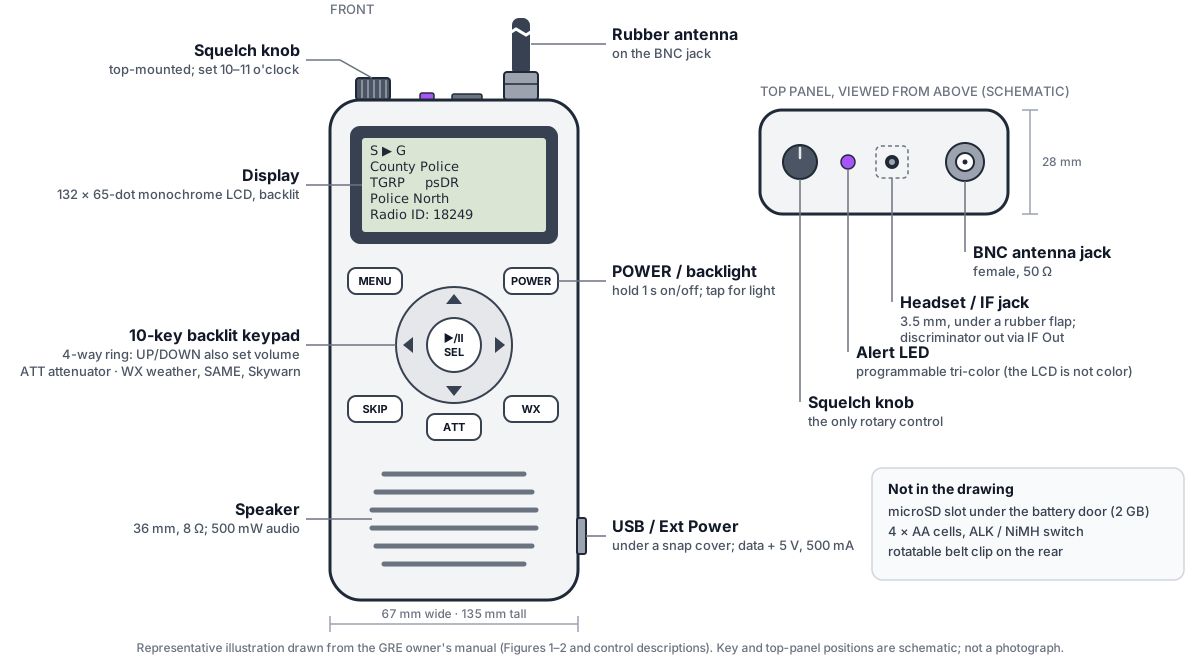
Case and size. The manual describes a “slim, compact case design with textured exterior finish and large speaker”. It measures about 135 × 67 × 28 mm (5 5/16 × 2 1/8 × 1 1/16 in) and weighs about 210 g (7.4 oz) without batteries or accessories. The RadioReference wiki gives 13.4 oz with batteries and antenna. That is ordinary handheld-scanner size, closer to a thick deck of cards than a pager, and noticeably smaller than the touchscreen HomePatrol. The manual is explicit that the radio is not waterproof, and it carries no ingress rating.
Display and alert LED. The screen is a backlit, high-contrast monochrome dot-matrix LCD of 132 × 65 dots, which the RadioReference wiki describes as six lines of 16 characters plus a relative signal-strength meter. A top row of icons reports squelch, signal strength, IF output, control-channel data, attenuator state, modulation (AM, FM, NF, DG/Dg for P25 with or without AGC, and E for encrypted traffic), scan or pause, recording and power source. Four characters, “psDr”, report priority, skip/lockout, delay and recording for the object on screen. The feature often described as “color” is not the display. It is GRE’s programmable tri-color Alert LED on the top panel, which can be set per object to thousands of colors and flash patterns; the manual’s Appendix A gives worked examples. A separate programmable backlight can also flash on activity.
Keypad. There is no numeric keypad. Ten backlit keys do everything:
- POWER: hold one second for on/off; a brief press toggles the backlight.
- MENU: context functions and the Main Menu.
- SKIP: temporarily skips an object; also stops playback, cancels menu changes, and toggles SAME standby in weather mode.
- ▶/II/SEL: scan, pause and select, at the centre of a round four-way ring.
- UP / DOWN: volume while scanning or monitoring, and scrolling elsewhere.
- LEFT / RIGHT: resume scanning without skipping, move in and out of menus and library levels, and jump five seconds back or forward in playback.
- ATT: cycles per-object attenuation, global attenuation mode, and global attenuation on.
- WX: NOAA weather at once; the dedicated SAME alert receiver; a second press selects the SKYWARN scanlist.
Volume is on the arrow keys, not a knob. How the keys are used in practice is covered in Vol 2.
Top panel. The manual’s front-view figure places four items on top:
- BNC female antenna connector, 50 Ω. This is BNC, not SMA, so mobile and base antennas with BNC plugs connect directly.
- Headset/IF connector: a 1/8-inch (3.5 mm) jack under a rubber flap. A plug mutes the internal speaker, and an external amplified speaker uses the same jack. Settings → IF Out routes the unsquelched, unfiltered discriminator signal here, for decoders such as Unitrunker.
- Squelch control: the radio’s only rotary control. The manual recommends the 10 to 11 o’clock position.
- Alert LED.
The supplied rubber antenna attaches with a quarter-turn BNC bayonet.
USB. The USB/Ext Power jack sits under a snap-open cover that the manual says to open with a fingernail or small screwdriver. The RadioReference wiki identifies it as USB mini-B. It is a composite USB device offering both mass storage (access to the microSD card without removing it) and a CDC serial port (control-channel data streaming and firmware updates). It is also the only external power input: 5 V at 500 mA from a PC, an AC USB adapter or a car USB adapter. Neither adapter was included. The manual describes no GPS input; location is entered by hand (Vol 2).
microSD card. The card is removable, not internal. It lives in a push-to-click slot under the battery door, and a 2 GB card came in the box, preformatted with the library and the PC software installer. It holds everything: the library, the active configuration, up to 200 V-Scanner folders and all recordings. The radio takes exclusive access to the card while it is on, so PC access requires the radio switched off. The card’s layout and formatting rules are in Vol 3.
Batteries and charging. Power comes from four AA cells. A Battery Type Selection switch inside the compartment sets the low-battery threshold for alkaline (6.0 V) or NiMH (4.8 V) cells and enables the built-in charger. The manual warns never to leave the switch at NiMH with alkalines installed while external power is connected. The charger is a slow, timer-controlled design that fully charges typical NiMH AAs in about 16 hours. It charges only while the radio is switched off; switched on, the radio runs from USB power but does not charge. Squelched current drain is about 170 mA. GRE did not publish a battery-life figure. Owner reports describe runtimes shorter than older scanners on ordinary cells and about 10 hours on high-capacity NiMH; those reports are unconfirmed. A low-battery warning sounds every 30 seconds, and the radio shuts itself down before the cells are exhausted so that the card is not corrupted. For the same reason the manual repeatedly instructs owners to turn the radio off before connecting or disconnecting external power.
Speaker and audio. A built-in 36 mm, 8 Ω dynamic speaker delivers up to 500 mW from a bridge-tied amplifier. The manual warns that some USB power supplies and computers radiate enough RF noise to interfere with reception.
Inside the receiver. The PSR-800 is a triple-conversion PLL superheterodyne, with IFs of 380.8 MHz, 21.4 MHz and 455 kHz. The CPU and DSP carry separately updatable firmware, so demodulation and P25 decoding are done in DSP software. It is not a direct-sampling software-defined receiver of the kind Uniden later marketed as TrueIQ. P25 voice uses DVSI’s IMBE vocoder, which the manual credits under US patents 5,870,405 and 5,517,511. The specific CPU, DSP and codec chips are not documented: no teardown was found, and the FCC file has no internal photographs. Sensitivity runs from 0.2 µV (VHF low) to 0.8 µV (300–406 MHz) at 12 dB SINAD, and scan speed is 70 channels per second. Coverage has real gaps, most notably nothing between 54 and 108 MHz, so there is no FM broadcast band and no wideband FM mode. The band-by-band table is in Vol 4. The RadioReference wiki notes that the family is sensitive but easily overloaded by strong nearby transmitters; the ATT key is the first remedy.
In the box. The manual lists the main unit, a 2 GB microSD card, the rubber antenna, a rotatable belt clip, a USB cable, and a CD with the manual, PC software and database. It lists no batteries and no AC adapter.
1.5 How it compares
The PSR-800’s closest contemporary is the Uniden HomePatrol-1, which shipped in September 2010, a few months earlier, and made the same bet: the RadioReference database on board and programming by location rather than by frequency. The RadioReference wiki describes the PSR-800 as the first scanner to ship the RadioReference database on its card. The HomePatrol-1, which also carried the database on microSD months earlier, complicates that claim; the difference lies in approach more than in date. The HomePatrol is a large colour-touchscreen appliance with an SMA antenna jack. Its database updates came free through Uniden’s Sentinel software, and location entry by ZIP code was its headline feature from day one. The PSR-800 is a smaller, keypad-driven handheld with a BNC jack, a discriminator output and an audio recorder, and it gained ZIP-code entry only with firmware 1.5 in 2012.
On P25 Phase II the positions reversed over time. The HomePatrol-1 never gained Phase II, and Uniden added it only in the 2014 HomePatrol-2. The PSR-800 received it as a free GRE firmware update in January 2013. What decided the long-term picture was support. Uniden still updates its database, while the PSR-800’s update servers disappeared with GRE (Vol 5). The HomePatrol is covered in its own deep dive: Uniden HomePatrol — Vol 1.
Sources
- GRE America, GRECOM PSR-800 EZ Scan-SD Digital Owner’s Manual (2011), FCC ID ADV0602902 exhibit — in this site’s Reference Library: GRE PSR-800 Owner’s Manual · all PSR-800 documents: Reference Library — GRE PSR-800
- FCC equipment authorization ADV0602902 (grant 2011-01-28): https://fccid.io/ADV0602902
- GRE press release, “GRE Introduces Next Generation Digital P25 Scanning Receiver” (2011-01-06): https://www.pr.com/press-release/288055
- GRE press release on firmware 1.5 Set Location programming (2012-01-11): https://www.24-7pressrelease.com/press-release/256245/gre-releases-major-firmware-update-for-grecom-psr-800
- RadioReference wiki — PSR-800: https://wiki.radioreference.com/index.php/PSR-800 · GRE PSR-800 based scanners: https://wiki.radioreference.com/index.php/GRE_PSR-800_based_scanners · WS1080: https://wiki.radioreference.com/index.php/WS1080 · Pro-668: https://wiki.radioreference.com/index.php/Pro-668 · Pro-18: https://wiki.radioreference.com/index.php/Pro-18
- rigpix, GRE PSR-800: https://www.rigpix.com/gre/psr800.htm
- Scanner Master, “Limited stock on GRE PSR-800” (2013-01-17): https://www.scannermasterblog.com/limited-stock-on-gre-psr-800-digital-police-scanner/
- SoCal Scanner, “GRE reportedly out of the scanner business” (2012-10-16): https://socalscanner.com/2012/10/gre-reportedly-out-of-the-scanner-business/
- RadioReference forums, Whistler acquires GRE’s assets (2013-09-19): https://forums.radioreference.com/threads/whistler-group-acquires-gres-assets-to-manufacture-radio-shack-scanner-product-line.274717/
- Whistler Group history (Goliad Products): https://whistlergroup.com/pages/whistler-history · new-ownership announcement: https://whistlergroup.com/blogs/news/press-release-new-ownership-of-whistler-group
- RadioReference forums, RRDB after Whistler’s closure (December 2024): https://forums.radioreference.com/threads/anyone-know-where-to-download-the-latest-rr-database-rrdb-now-that-whistler-is-out-of-business.482469/
- GRE company history: https://en.wikipedia.org/wiki/GRE_(company)
- Pricing reports: https://forums.radioreference.com/threads/how-much-should-a-gre-psr-800-cost.323294/ · https://forums.radioreference.com/threads/lowest-price-for-a-gre-psr-800.216761/
- Monitoring Times review summary (April 2011): https://forums.radioreference.com/threads/monitoring-times-psr-800-review.209053/
Comments (0)