Whistler TRX-1 / TRX-2 · Volume 1
Whistler TRX-1 / TRX-2 — Vol 1: Introduction & Hardware
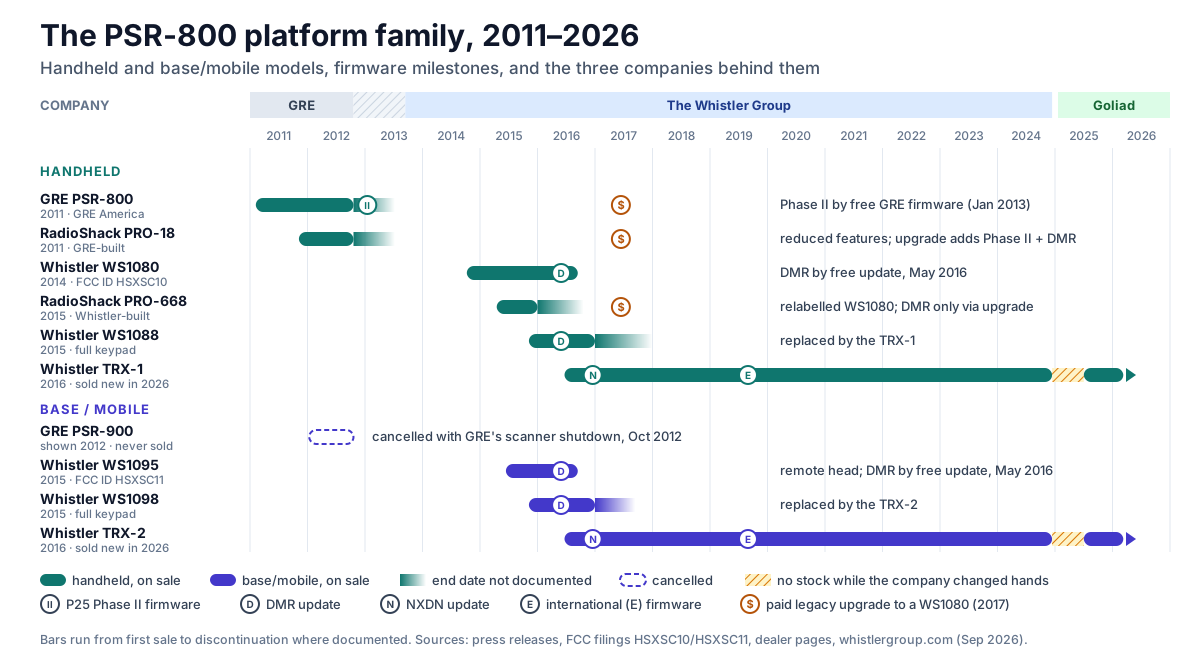
The last PSR-800-lineage scanners, with DMR and NXDN, sold new under Goliad Products
1.1 About this volume
The Whistler TRX-1 (handheld) and TRX-2 (base/mobile) are the final revision of the scanner platform GRE America launched with the PSR-800 in 2011. Whistler announced both on 17 May 2016 and shipped them in late June 2016. They are the only models of that family still manufactured. The Whistler Group stopped operating at the end of 2024, and Goliad Products LLC of Cincinnati bought its assets in January 2025. Goliad resumed selling both radios under the unchanged Whistler name. In September 2026 whistlergroup.com lists the TRX-1 at $599.99 and the TRX-2 at $679.99, both in stock.
Technically, the TRX line is a revision, not a redesign.
- Same receiver: triple-conversion superheterodyne with IFs of 380.8 MHz, 21.4 MHz and 455 kHz, the same frequency coverage, and a sensitivity table identical to the WS1080’s and the PSR-800’s.
- Same cases: the TRX-1 uses the WS1080 handheld case, and the TRX-2 uses the two-piece WS1095/WS1098 chassis with its detachable magnetic head.
- Same certification: the FCC treats them as revisions. The TRX-1 guide prints FCC ID HSXSC10, the WS1080’s grant, and the TRX-2 guide prints HSXSC11, the WS1095’s grant.
What changed:
- CPU flash: 512K against the WS series’ 384K. This figure comes from the developer of the unofficial PSR-800 firmware patches and is likely but not confirmed by Whistler.
- DMR from launch.
- NXDN, added free in December 2016. It needed the extra flash.
- Full alphanumeric keypad on both models.
- Protective case included with the TRX-1.
For a buyer in 2026, the TRX radios are the only members of the family with:
- a living manufacturer
- current firmware and library downloads
- a new-unit warranty
- NXDN
They also inherit the platform’s limits:
- DMR and NXDN: the scanner follows calls by scanning each site’s frequencies rather than tracking a control channel.
- P25 simulcast: owner reports describe weak performance.
Both limits are covered in Vol 2 and Vol 4.
This dive concentrates on what the TRX adds and on the Goliad era. Material shared with the rest of the family lives elsewhere:
- Receiver, object model, scanlists, Scan Sets, V-Scanner II, Spectrum Sweeper, SAME weather, and the microSD card and EZ Scan basics: the GRE PSR-800 dive.
- The two-piece chassis and its installation: the WS1095/WS1098 dive.
1.2 The family, and where the TRX fits
Table 1 — The family, and where the TRX fits
| Model | Maker / brand | Type | Introduced | Relationship |
|---|---|---|---|---|
| PSR-800 | GRE | Handheld | 2011 | The original design (dive) |
| PRO-18 | GRE for RadioShack | Handheld | 2011 | Reduced-feature badge variant |
| PSR-900 | GRE | Base/mobile | Shown 2012 | Cancelled when GRE stopped making scanners in October 2012 |
| WS1080 | Whistler | Handheld | Sep/Oct 2014 | PSR-800 with obsolete parts replaced (dive) |
| PRO-668 | Whistler for RadioShack | Handheld | 2015 | Relabelled WS1080 |
| WS1095 | Whistler | Base/mobile | June 2015 | The PSR-900 completed (dive) |
| WS1088 | Whistler | Handheld | November 2015 | WS1080 with a 23-key alphanumeric keypad |
| WS1098 | Whistler | Base/mobile | November 2015 | WS1095 with a full alphanumeric keypad |
| TRX-1 | Whistler (Goliad since 2025) | Handheld | June 2016 | WS1088 hardware revision: more flash, DMR at launch, NXDN |
| TRX-2 | Whistler (Goliad since 2025) | Base/mobile | June 2016 | WS1098 hardware revision: more flash, DMR at launch, NXDN |
| TRX-1E / TRX-2E | Whistler | Both | 2019 | International firmware and band plans for existing hardware |
The TRX-1 replaced the WS1088 and the TRX-2 replaced the WS1098; dealers list each as the successor. Whistler went on to announce successors called the TRX-100 and TRX-200 in 2018. Both are reported to have been abandoned before 2020, and neither was sold. No later model has been announced, by Whistler before 2024 or by Goliad since.
1.3 TRX-1 compared with the WS1080 and WS1088
Table 2 — TRX-1 compared with the WS1080 and WS1088
| Item | WS1080 | WS1088 | TRX-1 |
|---|---|---|---|
| FCC ID | HSXSC10 | HSXSC10 | HSXSC10 |
| Keypad | 10-key simple pad | 23-key backlit alphanumeric | Full backlit alphanumeric |
| CPU flash | 384K (likely) | 384K (likely) | 512K (likely) |
| DMR / MotoTRBO | Free update, 31 May 2016 | Free update, 31 May 2016 | At launch |
| NXDN | Never (flash too small) | Never | Free update, 15 December 2016 |
| Protective case in the box | No | No | Yes |
| Software on Goliad’s download page (2026) | EZ-Scan 2.51.0.707, CPU updater U4.8 | Shares the WS1080 package | EZ-Scan 3.48.0.708, CPU updater U5.9 |
| Status in 2026 | Discontinued | Discontinued | Sold new, $599.99 |
The TRX-1 guide’s specification page matches the WS1080’s line for line:
- Size and weight: 135 × 67 × 28 mm (5.31 × 2.12 × 1.06 in); 210 g (7.4 oz) without antenna and batteries.
- Display: 132 × 65-dot LCD.
- Audio: 36 mm 8 Ω speaker, 500 mW.
- Power:
- Four AA cells: 4.8 V NiMH or 6 V alkaline.
- External power and charging over USB at 5 V, 500 mA.
- Current drain of 170 mA squelched.
- Card: microSD, supported up to 32 GB. Cards larger than 2 GB must be formatted as the guide instructs.
- Alert LED: programmable tri-color. The RadioReference wiki notes that the preset yellow renders as yellow-green and suggests RGB F84035 for a true yellow.
- Battery life: dealer copy gives 7–13 hours on four AA cells.
The keypad is the WS1088’s layout, the WS1080’s design in a different faceplate. It allows systems, sites and talkgroups to be created and edited without a PC.
The front-end question. The RadioReference family page and some forum posts say the TRX added better front-end filtering against overload. The evidence does not settle it:
- The published specifications are identical.
- The only FCC permissive change filed near the TRX launch (9 May 2016) describes replacing “several non-RF related parts”.
- A 2017 forum comparison of a TRX-1 against a WS1088 found little or no difference.
The claim remains unconfirmed. At most the improvement is minor, and it would matter mainly for overload from local FM broadcast transmitters.
1.4 TRX-2 compared with the WS1095 and WS1098
Table 3 — TRX-2 compared with the WS1095 and WS1098
| Item | WS1095 | WS1098 | TRX-2 |
|---|---|---|---|
| FCC ID | HSXSC11 | HSXSC11 | HSXSC11 |
| Head keypad | Simplified function keys | Full backlit alphanumeric | Full backlit alphanumeric |
| DMR / MotoTRBO | Free update, 31 May 2016 | Free update, 31 May 2016 | At launch |
| NXDN | Never | Never | Free update, 15 December 2016 |
| Software on Goliad’s download page (2026) | EZ-Scan 2.51.0.707, CPU updater U4.0 | Uses the WS1095 package (inferred) | EZ-Scan 3.48.0.708, CPU updater U5.0 |
| Launch price | No MSRP found | No MSRP found | $729.95 MSRP (Whistler, December 2016) |
| Status in 2026 | Discontinued | Discontinued | Sold new, $679.99 |
The TRX-2 guide’s specification page is the WS1095/WS1098 page with DMR, MotoTRBO Tier II and NXDN added to the receiving modes.
-
Remote head: detaches with a release button on the left side and re-attaches on guide pins, held by rare-earth magnets. It connects to the base over an RS-485 link on a straight 8P8C cable. The supplied cable is 6½ ft, and straight CAT5/CAT6 cables work up to 100 ft. A crossover cable can damage both the head and the base.
-
Where things are:
- Head: headphone jack, USB port and LCD.
- Base, behind the head: full-size SD card slot, taking cards up to 32 GB.
- Rear panel: BNC antenna jack, 3.5 mm external-speaker jack, and a 13.8 V DC jack.
-
Power: 12–14.4 V DC, rated 600 mA, centre positive. The DC cord has bare leads and an in-line 3 A slow-blow fuse; there is no cigarette-lighter plug.
-
Audio: 500 mW into 8 Ω from a speaker in the base unit; the head has none.
- Speaker size: the manual says 77 mm, the RadioReference wiki says 36 mm.
- Mobile installs: a head mounted away from the base usually needs an external speaker.
-
Missing ports:
- no GPS port
- no serial port
- no separate line or record output
The discriminator signal is routed to the headphone jack through the IF Out setting.
-
Size and weight: 45 × 180 × 135 mm (1.75 × 7.125 × 5.31 in). The manual prints “33.5 oz (9500g)”, a typo for about 950 g.
-
Bundled SD card: 4 GB in some sources and 2 GB in others. It probably varied between production runs.
The quick start guide lists the contents:
- scanner, antenna, AC adapter, USB cable
- mounting bracket with two knobs and five rubber feet
- remote head mounting bracket and the LAN cable for the head
- DC cable with fuse
- screws and washers
- SD card, installed
Mounting the base and head, running the head cable, and wiring DC power are the same as on the WS1095/WS1098; the WS1095/WS1098 dive covers them.
1.5 The international TRX-1E and TRX-2E
The TRX-1E and TRX-2E are not separate hardware. In August 2019 a Whistler representative described them as a firmware and PC-application conversion of existing TRX-1 and TRX-2 units. This rests on a forum announcement and is likely rather than confirmed. The conversion:
- adds non-US band plans
- removes the US and Canada band plans and the weather radio
- can be reversed
Whistler’s band-plan addendum (revision 09C22, 2022, “Compatible with CPU Version 7.4”) gives coverage tables for eighteen countries: the United Kingdom, Australia, New Zealand, France, South Africa, the Netherlands, Sweden, Poland, the Czech Republic, Belgium, Germany, India, Ireland, Spain, Denmark, Israel, Switzerland and Turkey. Each country gets its own ranges, steps and service searches. For example:
- United Kingdom: 25–88, 108–512, 806–960 and 1240–1300 MHz, with UK service searches including PMR446 and UK CB.
- Australia: 25–54, 70–87.5, 108–174, 216–520, 758–960 and 1240–1300 MHz.
Every E band plan still excludes the North American cellular blocks, 824–849 and 869–894 MHz.
In 2026 Goliad’s download page carries:
- a separate international EZ-Scan (3.45.0.723)
- a CPU updater (U7.4) for each E model
- per-country configuration archives, several dated as recently as 2026
Vol 2 covers loading them.
1.6 Against the Uniden SDS100 and SDS200
The TRX radios are usually compared with Uniden’s SDS100 handheld and SDS200 base/mobile, which occupy the same price tier. The Uniden facts here follow this project’s SDS100 and SDS200 dives.
Table 4 — Against the Uniden SDS100 and SDS200
| Item | Whistler TRX-1 / TRX-2 | Uniden SDS100 / SDS200 |
|---|---|---|
| Receiver | Triple-conversion superheterodyne with DSP decoding | TrueIQ I/Q baseband processing |
| P25 simulcast (LSM) | Owner reports describe weak performance | Uniden’s strength; the usual forum recommendation for simulcast areas |
| DMR / MotoTRBO | Included; followed by scanning site frequencies | Paid key (about $60); control-channel trunking |
| NXDN | Included free since December 2016; site-frequency scanning | Paid key (about $50) |
| EDACS ProVoice | Not supported | Paid key |
| Display | 132 × 65-dot monochrome LCD | Color (240 × 320 on the SDS100; 3.5 in, 480 × 320 on the SDS200) |
| Programming data | EZ-Scan with the RadioReference library; no RadioReference account needed | Sentinel with Uniden’s free weekly database |
| Launch list price | $649.95 / $729.95 (2016) | $699 (2018) / $749 (2019) |
| New price, September 2026 | $599.99 / $679.99 from Goliad | Not surveyed here |
The trade-off is simple to state:
- TRX: DMR and NXDN come in the box, at a lower price, with a keypad-driven radio that can be programmed without a PC.
- SDS: better P25 simulcast reception and real control-channel trunking on DMR and NXDN, backed by a larger manufacturer.
Vol 4 turns this into buying guidance.
Sources
- Whistler TRX-1 User Guide (SCA-TRX-1-UG-08A18; FCC ID HSXSC10): Reference Library
- Whistler TRX-2 User Guide (SCA-TRX-2-UG-10A17; FCC ID HSXSC11): Reference Library
- Whistler TRX-2 Quick Start Guide: Reference Library
- Whistler TRX-1E/TRX-2E band-plan addendum (09C22): Reference Library
- Whistler press release, “Whistler Launches DMR Capable Scanners” (17 May 2016): https://www.prweb.com/releases/whistler_launches_dmr_capable_scanners/prweb13422923.htm
- Whistler press release on the NXDN update, with MSRPs (15 December 2016): https://www.prweb.com/releases/whistler_to_update_trx_1_trx_2_scanners_with_nxdn_/prweb13922810.htm
- Scanner Master, Whistler TRX-1/TRX-2 Ultimate Review (July 2016): https://www.scannermaster.com/Special_Report_Whistler_TRX1_TRX2_Police_Scanner_Ultimate_Review_a/402.htm
- FCC grant records: https://fccid.io/HSXSC10 and https://fccid.io/HSXSC11
- RadioReference wiki, GRE PSR-800 based scanners, TRX-1 and TRX-2: https://wiki.radioreference.com/index.php/GRE_PSR-800_based_scanners · https://wiki.radioreference.com/index.php/TRX-1 · https://wiki.radioreference.com/index.php/TRX-2
- RadioReference forum, flash-size discussion (384K vs 512K): http://forums.radioreference.com/index.php?threads/344909/
- RadioReference forum, TRX-1 vs WS1088 RF comparison (2017): http://forums.radioreference.com/index.php?threads/356941/
- RadioReference forum, TRX-1E/TRX-2E announcement (August 2019): https://forums.radioreference.com/threads/new-trx-1e-and-trx-2e-international-models.393667/
- Goliad Products / Whistler product and download pages (read 2026-09-15): https://whistlergroup.com/collections/radio-scanners · https://whistlergroup.com/pages/downloads
Comments (0)