Whistler WS1095 / WS1098 · Volume 1
Whistler WS1095 / WS1098 — Vol 1: Introduction & Hardware
The PSR-800 platform as a base/mobile scanner with a remote head (2015)
1.1 About this volume
The Whistler WS1095 and WS1098 are the base/mobile versions of the GRE PSR-800 platform. Inside is the same object-oriented, library-on-card P25 scanner as the PSR-800 handheld: triple-conversion receiver, the RadioReference USA and Canada library on the card, Scanlists and Scan Sets, Spectrum Sweeper, SAME weather, recording and a discriminator output. The package around it is new. A desktop/mobile base unit carries the receiver, speaker and rear-panel connections. A remote head holds the display, keypad and front jacks, clamps onto the base with rare-earth magnets, and can be pulled off and run up to 100 feet away over an ordinary straight network-style cable.
The design has an unusual history: it was announced by one company, cancelled, and finished by another three years later. That story, the difference between the two models, and a hardware tour are the subject of this volume. The platform itself is not re-explained here. Operation, programming and the card are covered in the PSR-800 dive’s Operations and Programming volumes; Vol 2 of this dive covers only what the base/mobile sets do differently.
Neither scanner is in the owned lineup. The dive is written as a reference and a buyer’s guide.
1.2 The PSR-900 that never shipped
GRE America showed a base/mobile PSR-800 sibling, the PSR-900, at the Consumer Electronics Show in January 2012. Attendee photos and descriptions from the show describe a detachable remote head held on by two magnets, and specifications “the same as the PSR-800”. GRE had a booth at the Dayton Hamvention that May; that the PSR-900 was on display there rests on a single later forum remark and could not be confirmed.
The announced specifications, repeated by dealers and by the Southern California Monitoring Association in September 2012, were:
- coverage matching the PSR-800 (25–54, 108–174, 216–512, 764–960 MHz excluding cellular, and 1240–1300 MHz);
- a magnetic remote-mount head;
- a card preloaded with the US and Canadian database, with ZIP/city programming (the same announcement calls the card both “2 GB SD” and “microSD”, a contradiction never resolved);
- P25, Motorola, EDACS and LTR trunking, CTCSS/DCS, SAME weather, service searches and Spectrum Sweeper;
- user-upgradable CPU firmware; price “TBA”.
In September 2012 GRE America estimated an October/November 2012 ship date. Weeks later, in early October 2012, GRE-Japan told its US sales and development team that scanner manufacturing was shut down, and on 18 October the association’s newsletter reported that the PSR-900 “won’t be happening”. No business reason for the shutdown was ever published. A few pre-production units reached collectors; one owner reported that the unit could not load P25 Phase II firmware, which fits forum descriptions of a cross-model protection scheme in GRE and Whistler firmware (unconfirmed).
1.3 Whistler finishes the design
Whistler announced in September 2013 that it had acquired GRE’s scanner technical assets, at first to build RadioShack’s scanner line; at that point it had no details on the PSR-800/PSR-900 series. Production under Whistler began in 2014, starting with the PSR-800 rebuilt as the WS1080 handheld.
The base/mobile set followed. Whistler’s press release of 6 April 2015 introduced the “long awaited” WS1095, quoting Wayne Wilson — formerly GRE America’s executive vice president, by then Whistler’s vice president for scanners. It reached retail in June 2015. The WS1095 kept the PSR-900 concept but changed details: the production unit takes a full-size SD card behind the head rather than a microSD, and it was certified by the FCC under ID HSXSC11 (original grant 9 April 2015).
1.4 WS1095 and WS1098
On 11 September 2015 Whistler announced the WS1098 alongside the WS1088 handheld, for November 2015 availability. The difference is the head:
- The WS1095 head has the simplified PSR-800-style control set — Scan, Pause, Skip, navigation and function keys — with no numeric keypad.
- The WS1098 head has a full backlit alphanumeric keypad with a raised homing bar on the 5 key, so systems, sites and talkgroups can be entered and edited without a PC.
The FCC filing lists the WS1098 as a variant of the WS1095 differing in “the circuit attached to the screen”. Everything else — receiver, base unit, connectors, head cable, accessories and user guide — is shared. One manual covers both.
Whistler released a free DMR update for both models on 31 May 2016. By September 2016 Scanner Master and Whistler said the WS1095 was discontinued in favour of the WS1098, and the WS1098 was later listed as replaced by the TRX-2. No manufacturer’s suggested retail price for either model was found in a primary source; 2016 street prices are given in Vol 3.
1.5 The TRX-2 successor
The Whistler TRX-2, announced 17 May 2016 and shipped in late June 2016, is the same chassis with the WS1098’s keypad head, DMR built in and more memory. The extra memory let Whistler add NXDN by a free update in December 2016 — something the WS1095 and WS1098 never received. The TRX-2 prints the same FCC ID, HSXSC11, in its manual. Goliad Products, which bought Whistler’s assets in January 2025, still sells the TRX-2 new; it does not sell the WS1095 or WS1098. The TRX-2 has its own dive, Whistler TRX-1 / TRX-2.
No RadioShack base/mobile twin was built on this platform. RadioShack’s last digital desktop, the PRO-652, is a WS1065 twin on the older PSR-500/600 platform, and RadioShack’s February 2015 Chapter 11 filing came two months before the WS1095 launched.
1.6 Hardware tour
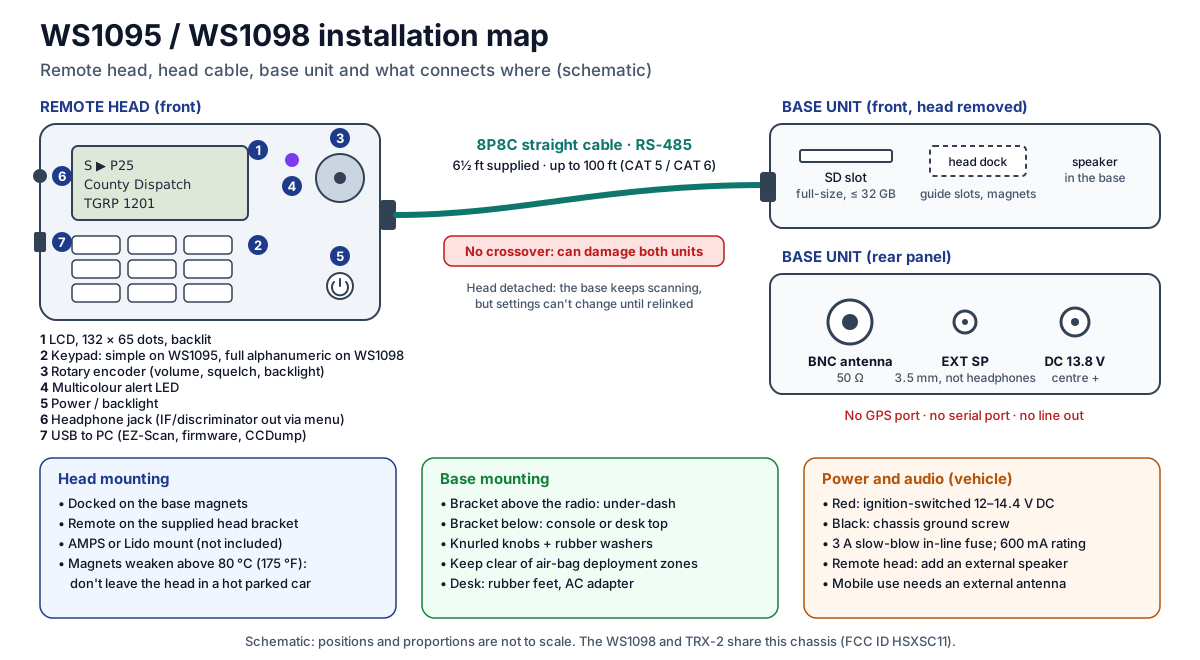
Figure 1 shows where everything connects. Facts in this section come from the WS1095/WS1098 User Guide (rev 12E15) and, for the shared chassis, the TRX-2 User Guide (rev 10A17).
The remote head. The head is the whole user interface: a backlit 132 × 65-dot monochrome LCD (about 1 × 1¾ in, up to six lines), the keypad, a rotary encoder, a power/backlight button, a programmable multicolour alert LED, a headphone jack, and a USB connector for the PC. The manual specifies only “USB 2.0 or earlier”; dealers and the RadioReference wiki describe the connector as Mini-USB. The headphone jack also carries the scanner’s IF/discriminator output when the IF Out setting routes it there. The head has no speaker; audio comes from the base.
The head clips to the base with guide pins and magnets. A release button on the left side of the base frees it. The manual warns that the rare-earth magnets are strong enough to trap fingers, must be kept away from pacemakers and magnetic media, and are permanently weakened above 80 °C (175 °F) — a real concern for a head left on a dashboard in a parked car. The rear of the head has the latch, magnet sockets and the cable jack; it can also be fitted to an AMPS or Lido mount, which is not included.
The head cable. Base and head talk over an RS-485 link carried on an 8P8C modular cable, Type B, straight. The supplied cable is 6½ ft; any straight CAT 5 or CAT 6 cable can be used up to 100 ft. The manual’s warning is explicit: crossover cables and other cable types “may damage both the remote head and base unit”. With the head detached and no cable, the base keeps scanning, but no changes can be made until the head is reconnected.
The base unit, front. With the head removed, the front of the base exposes the full-size SD card slot (cards up to 32 GB; the WS1095 press release gives the bundled card as 4 GB), the head connector and the docking slots.
The base unit, rear. Three connections: a BNC antenna jack (50 Ω), a 3.5 mm “EXT. SP” external speaker jack (the manual warns against using it for headphones), and a “DC 13.8V” coaxial power jack, centre positive. The built-in speaker is a 77 mm, 8 Ω dynamic driver on a 500 mW BTL amplifier (the RadioReference wiki’s TRX-2 page gives 36 mm; the manual’s 77 mm is used here).
Power. The scanner needs 12–14.4 V DC at 600 mA (13.8 V nominal, 16 V maximum). The supplied DC cord has bare red and black leads and an in-line 3 A slow-blow fuse; an AC adapter is also in the box. There is no internal battery.
Size. 45 × 180 × 135 mm (1.75 × 7.125 × 5.31 in, H × W × D) and about 950 g (33.5 oz). The manual prints “9500g”, a typo that the RadioReference wiki repeats as 9.5 kg.
In the box: the scanner with remote head, a pull-up BNC antenna, USB cable, the SD card (installed, with the PC software on it), the 6½ ft head cable, a head mounting bracket and screws, the main mounting bracket with knurled knobs and rubber washers, the DC power cable, the AC adapter, the user guide and a quick-start guide.
1.7 What is missing
The absences matter as much as the features, especially next to later scanners:
- No GPS input. Neither “GPS” nor a serial port appears in the manual. Location comes from a city, ZIP or county entered by hand, so the scanner does not re-select sites as a vehicle moves.
- No serial (DB-9) port and no network or Wi-Fi. PC control and data go over the head’s USB connector only.
- No line or record output. Recording goes to the SD card; the only raw-signal output is the discriminator on the headphone jack.
- No speaker in the head. A vehicle install with the head away from the base needs an external speaker on the rear jack.
- No battery. It is a 12 V set.
1.8 How it compares
A buyer weighing a used WS1095 or WS1098 is usually also looking at Uniden’s base/mobile scanners. At a glance:
Table 1 — A buyer weighing a used WS1095 or WS1098 is usually also looking at Uniden's base/mobile scanners. At a glance
| WS1095 / WS1098 | Uniden BCD536HP | Uniden SDS200 | |
|---|---|---|---|
| Released | 2015 | 2014 | 2018 |
| Receiver | Triple-conversion superheterodyne | Conventional heterodyne | TrueIQ I/Q sampling |
| Display | 132 × 65-dot mono, in a remote head | Colour dot-matrix, fixed front panel | 3.5 in 480 × 320 colour, fixed front panel |
| Remote head | Yes, up to 100 ft | No | No |
| P25 Phase I/II, X2-TDMA | Built in | Built in | Built in |
| DMR | Free 2016 update (site scanning, see Vol 2) | Paid key | Paid key |
| NXDN / ProVoice | Never | Paid keys | Paid keys |
| GPS | None | Via DB-9 serial port | GPS jack |
| Networking | None | Wi-Fi dongle included | Ethernet |
| Discriminator out | Yes, via headphone jack | No | No |
| Card | Full-size SD | microSD | microSD |
Uniden facts are from this site’s BCD536HP and SDS200 dives. The WS1095/WS1098’s real strengths are the separable head and the discriminator output; its weaknesses are the absent GPS, no NXDN or ProVoice at any price, and a support situation covered in Vol 4.
Sources
- Whistler WS1095/WS1098 User Guide, rev 12E15 (hardware, connectors, power, package contents, specifications): Reference Library
- Whistler TRX-2 User Guide, rev 10A17 (same chassis; remote head, LAN cable specification, mounting and power): Reference Library
- FCC ID HSXSC11 grant and variants: https://fccid.io/HSXSC11
- Whistler press releases: WS1095 (6 Apr 2015) https://www.prweb.com/releases/whistler_introduces_long_awaited_ws1095_scanner/prweb12630054.htm; WS1088/WS1098 (11 Sep 2015) https://www.prweb.com/releases/whistler_introduces_new_ws1088_and_ws1098_scanners/prweb12952074.htm; TRX-1/TRX-2 and DMR (17 May 2016) https://www.prweb.com/releases/whistler_launches_dmr_capable_scanners/prweb13422923.htm
- RadioReference forum, PSR-900 pre-release thread (CES 2012 photos and description): https://forums.radioreference.com/threads/gre-psr-900-pre-release-thread.230289/
- Southern California Monitoring Association, Monitoring Post, September 2012 (PSR-900 preview and ship estimate): https://socalscanner.com/wp-content/uploads/2012/09/09-2012-Monitoring-Post.pdf; October 2012 report of GRE’s exit: https://socalscanner.com/2012/10/gre-reportedly-out-of-the-scanner-business/
- Whistler’s acquisition of GRE assets (Sept 2013): https://socalscanner.com/2013/09/whistler-group-acquires-gres-assets-to-manufacture-radio-shack-scanner-product-line/
- Universal Radio, PSR-900 page (“Cancelled by GRE… Replaced by the Whistler WS1095”): https://www.universal-radio.com/catalog/scanners/4900.html
- RadioReference wiki, GRE PSR-800 based scanners: https://wiki.radioreference.com/index.php/GRE_PSR-800_based_scanners; WS1095: https://wiki.radioreference.com/index.php/WS1095
- Scanner Master, WS1095 and WS1098 product pages (discontinuation): https://www.scannermaster.com/Whistler_WS1095_Digital_Base_Mobile_EZ_Scanner_p/55-501899.htm · https://www.scannermaster.com/Whistler_WS1098_Digital_Base_Mobile_EZ_Scanner_p/55-501910.htm
Comments (0)