Uniden BC355N · Volume 1
Uniden BC355N — Vol 1: Introduction & Hardware
Compact analog scanner — NASCAR/race-day staple
1.1 About this volume
The Uniden BC355N is the compact mobile analog scanner in the lineup — a small, plain, conventional analog receiver introduced around 2008-2010 that Uniden has kept in continuous production for nearly two decades because the NASCAR / IndyCar / road-racing market keeps buying it every spring. A deliberately minimal radio: 800 channels, conventional analog FM only, no trunking, no digital, no SD card, no GPS, no Bluetooth.
The bench role is the always-in-vehicle backup scanner that doesn’t need attention — sits in the truck on a hardwired 12 V tap, decodes anything analog on conventional public-safety, race-team, marine, GMRS/FRS, or aviation channels, never gets touched. When the flagship SDS100 ↗ or SDS200 ↗ is in the shack or on the belt, the BC355N is the one that stays in the vehicle. Street price mid-2026 USD around $130-170 new, $80-120 used — cheap enough to leave in a vehicle the writer would not leave a $700 SDS100 in.
Why this radio still earns a slot in 2026 against trunked/digital flagships: conventional analog UHF is what every NASCAR, IndyCar, IMSA, NHRA, and most SCCA / club race team broadcasts on — licensed business-band UHF, point-to-point voice without trunking latency or trust dependencies. A flagship trunking scanner is wasted on a single conventional channel; the BC355N hears exactly the same audio. Factory-loaded with the major US public-safety conventional frequencies, NOAA weather, marine, and racing service banks. Low current draw (<500 mA), tolerates 11-14 V from any vehicle / deep-cycle battery. Survives a week parked in the driveway on a 7 Ah AGM with no engine charging.
What this volume does not cover, because the radio cannot do it: P25 Phase I/II, DMR, NXDN, ProVoice, EDACS, Motorola trunking, LTR, OpenSky, MPT-1327, any encrypted system, simulcast correction, GPS site selection, Wi-Fi, SD recording, or audio recording. For any of those, see SDS100 ↗, SDS200 ↗, or BCD536HP ↗. The BC355N is intentionally the dumb end of the lineup.
Sibling context inside the legacy-Uniden cluster: BC246T (Vol 17) ↗ is the legacy handheld trunking scanner (Trunk Tracker III, analog trunking only); BC350A (Vol 18) ↗ is the legacy desktop analog conventional — same feature class in a base chassis; Homepatrol (Vol 20) ↗ is the zip-code-programmable digital — much more capable but not the right answer for “always in the vehicle.”
1.2 Hardware tour
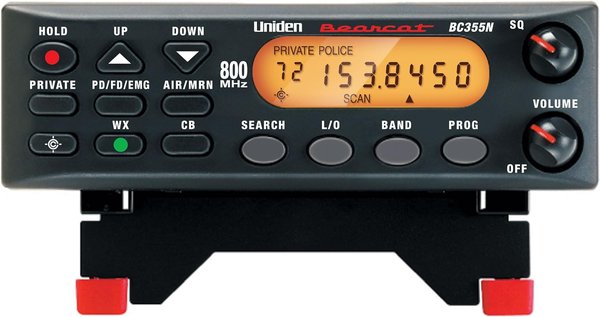
The BC355N chassis is approximately 5.9” × 2.6” × 1.4” (150 × 66 × 35 mm), roughly the volume of a slim paperback. Plastic case, metal chassis inside, front-panel speaker, single rotary volume/squelch knob, and a small membrane-button cluster (Hold, Scan, L/O, Lock, Func, and the dual-function numeric keys).
Display: multi-line LCD with red/orange LED backlight, showing the active channel number, bank, frequency, and alpha tag (where programmed via PC software — front-panel programming is numeric only). Readable in direct sunlight at the right dash angle, dimmable for night driving via a manual backlight key (no ambient sensor).
Antenna jack: BNC, rear panel. The right choice for receive-only mobile scanning — mates cleanly with a BNC-to-NMO adapter and any mag-mount or hardwired NMO antenna. The stock ~15-20 cm BNC stub is adequate for desktop bench use and useless in a vehicle; replace immediately (see §6).
Power: 13.8 V DC nominal via a 2.1 mm coaxial barrel jack (center-positive, universal Uniden convention). Ships with a cigarette-lighter cord and a wall-wart AC adapter (~12 V DC, 500 mA). For permanent vehicle install, replace the cigarette-lighter cord with a hardwired tap to an accessory-switched fuse circuit. Current draw 200-450 mA depending on volume and backlight.
External speaker jack: 3.5 mm mono on the rear; disables the internal speaker when plugged in. This is the under-dash use case: hide the radio in the glove box, run audio to a 3” panel-mount speaker on the dash.
PC programming jack: USB-mini-B on the rear (current revision — earlier production used a proprietary 4-pin or RJ-style jack with a separate Uniden cable). Enumerates as a virtual COM port via a Prolific or FTDI bridge inside the radio.
Internal layout (per teardown reports): single PCB with a discrete superhet front end, audio amp, and a microcontroller running Uniden house firmware. No FPGA, no SDR front end — a classic 2000s-era heterodyne scanner. The architecture is exactly why the radio is small, cheap, and analog-only. No battery compartment; for battery-powered use, run from an external 12 V pack via the barrel jack.
Comments (0)