Uniden BC246T · Volume 1
Uniden BC246T — Vol 1: Introduction & Hardware
Analog Motorola Type II + EDACS + LTR trunking
1.1 About this volume
The Uniden BC246T is the legacy handheld trunking scanner in the lineup — a circa-2005 Trunk Tracker III handheld that earned its keep monitoring analog Motorola Type II / EDACS / LTR trunked systems for the better part of a decade and now lives in the bench drawer as an archival/sentimental keepsake. It is honestly not a first-pick for monitoring in 2026. The radios that superseded it — the BCD396XT (Vol 16) ↗ for digital trunking and the SDS100 (Vol 13) ↗ for everything — get the active use; the 246T comes out when the question is “what does this analog Motorola Type II county sheriff system actually sound like in the wild” or when nostalgia outranks coverage.
The honest framing is important. The 246T predates P25 in this product class. There is no digital decode — no P25 Phase I, no P25 Phase II, no DMR, no NXDN, no DStar, no Tetra. The trunking decoder handles only the analog Motorola families (Type II, Type IIi Hybrid, Motorola fleet/subfleet maps), EDACS Wide/Narrow (the 9600 baud Ericsson/M/A-COM control channel format that ran on the old EDACS systems in the late 1990s and 2000s), and LTR (the older Logic Trunked Radio format that lingered on small commercial systems). Voice on the trunked talkgroups is FM, full-stop. If your county has moved to a Phase II P25 simulcast — and most have, somewhere between 2010 and 2020 — the 246T sees the control channel as noise and the voice channels as silent carriers it can’t unmute.
Where it earns the bench slot today:
- Analog Motorola Type II survivors. A handful of rural county sheriffs, fire departments, public-works fleets, NASCAR pit-row teams, and small business trunked-radio systems are still on analog Motorola Type II in 2026, mostly because the upgrade cost to P25 hasn’t been justified. The 246T tracks these correctly.
- Historical reference. It’s the radio that taught a generation of scanner listeners what “trunk tracking” meant. The control-channel-following architecture is the same conceptually as a modern P25 trunking scanner — the 246T is just stuck at the analog edge of that evolution.
- A second-or-third backup that runs forever on AA cells. Two AA NiMH or alkaline cells give it 6-8 hours of scan time. The flagships need proprietary Li-ion packs that age out; the 246T runs on whatever’s in the kitchen drawer.
This radio was bought when it was current. It is kept partly because it still works correctly within its band of competence, partly because the analog Motorola Type II decoder is genuinely good, and partly because throwing away a radio that was bought new and still functions feels wrong. It is not the radio that goes in the go-bag in 2026; it is the radio that sits on the shelf and gets pulled out twice a year.
1.2 Hardware tour
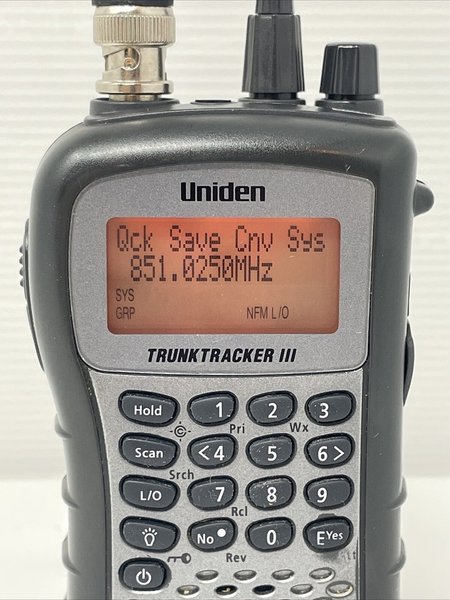
The 246T is a small handheld, roughly the size of a 1990s analog cell phone:
- Form factor: ~115 × 65 × 33 mm, ~200 g with batteries. Belt clip on the back.
- Display: monochrome LCD, ~64 × 128 pixels, with a green backlight on a press-button timeout. Five lines of text in scanning mode (system, group, channel tag, frequency, signal strength).
- Battery: 2× AA cell. Either NiMH (the right call for daily use — modern Eneloop 2000-2500 mAh give 6-8 hours of scanning) or alkaline (fine for emergency use, dies fast under scanning load). Charges NiMH internally via the DC input when the appropriate menu setting is enabled. No proprietary battery pack.
- Antenna jack: BNC. Stock antenna is a short rubber duck that’s mediocre on every band. BNC means an enormous aftermarket of dual-band whips, mag-mounts, and outdoor verticals attaches with a $3 BNC-to-SMA or BNC-to-N adapter.
- Programming jack: mini-USB (on later production runs) or 1/8” stereo jack with a Uniden-proprietary pinout requiring a USB-to-serial cable (earlier production). The radio in the bench drawer is the mini-USB variant.
- Audio: internal speaker on the back; 1/8” jack on the side for an earpiece or external speaker. The internal speaker is loud enough for a quiet room and inadequate in a moving car.
- Controls: rotary knob (volume + push for power), squelch knob, four-way navigation pad, ten-key numeric pad, menu/function/scan/hold/manual buttons. Direct frequency entry works the way it does on every Uniden scanner of this era — type the frequency, hit ENT, the radio jumps.
- Frequency coverage: 25-512 MHz, 806-956 MHz (cellular blocked per US Part 15.121), with gaps. No 700 MHz public-safety coverage (the 763-775 / 793-805 MHz public-safety allocation came after this radio’s design freeze and is not in the band plan). No 1.2 GHz coverage either.
- Capacity: 2500 conventional channels organized into systems/groups, plus trunking system/talkgroup lists. The organization model is the older Uniden “dynamic memory” architecture — channels live inside named systems and groups, not in flat 100-channel banks like the BC350A.
The build quality is fine for a 2005 consumer scanner. The case plastic is hard ABS, the rotary controls have not gotten scratchy with age, the LCD has not bled or developed dead pixels. The mini-USB jack is the weakest mechanical point on the design — if you program it frequently, the jack eventually loosens. Replacement jacks are a 15-minute solder job on the main board if it ever comes to that.
Comments (0)