Uniden BC350A · Volume 1
Uniden BC350A — Vol 1: Introduction & Hardware
Pre-trunking 100-channel desktop base
1.1 About this volume
The Uniden BC350A is a 1990s-era pre-trunking analog desktop “Bearcat” scanner. It earns its slot on the bench for historical and sentimental reasons rather than operational ones — it was the radio that, alongside the BC246T (Vol 17) and BC355N (Vol 19), introduced the scanning hobby before P25 and trunked-digital monitoring became the dominant requirement. The flagship daily drivers in this category are now the SDS100 (Vol 13) and SDS200 (Vol 14); the Homepatrol (Vol 20) covers the zip-code-programmable archival case.
The bench role is archival. The BC350A has no trunking decoder (no Motorola Type I/II, no EDACS, no LTR), no digital decoder (no P25, no DMR, no NXDN), and no PL/DPL tone-controlled squelch (or a very limited subset depending on the exact variant — see the variant flag below). It is a conventional analog scanner: 100 memory channels, manual programming via the front-panel keypad, conventional FM scan with priority. It hears clearly on bands where conventional analog still exists — local ham 2 m and 70 cm repeaters, NOAA weather, aero VHF AM (108-137 MHz, where the receiver covers that band — verify; the AM-mode question is itself variant-dependent), marine VHF, and the small remaining set of public-safety agencies that haven’t migrated to trunked-digital. For everything else, the modern Uniden flagship line does the job better, with searchable databases, RadioReference integration, and full P25 Phase II decoding.
TBD — verify against the actual bench unit: the “BC350” Uniden Bearcat lineage included at least three distinct SKUs that are commonly confused: BC350A, BC350C, and BC350XLT. They are different products with overlapping but non-identical specifications — memory capacity (some are 100 ch, some are 50, some are 200), band coverage (some include 800 MHz cellular gaps, others don’t), squelch features (some support CTCSS/DCS, others don’t), and even the front-panel layout differs. The text below assumes BC350A; every spec marked TBD — verify should be cross-checked against the unit’s label before being treated as authoritative.
1.2 Hardware tour
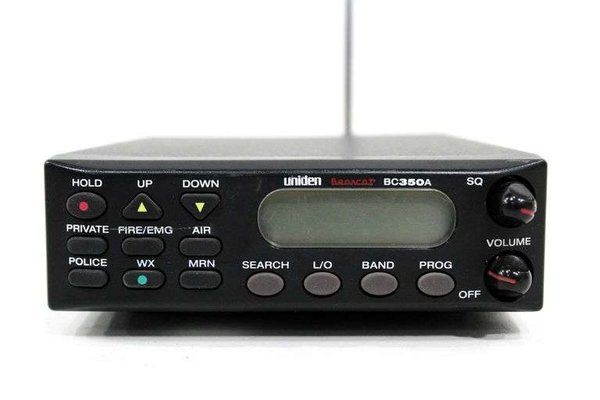
Form factor. Tabletop, plastic case, intended to sit on a desk or shelf rather than mount in a vehicle (though the BC350-family chassis is small enough that mobile installation is plausible). Approximate dimensions ~190 × 130 × 50 mm; mass ~1 kg with internal speaker. The hallmark Uniden “Bearcat” industrial design — squared-off case, prominent rotary controls on the right, keypad on the left, LED display centered above the keypad.
Power. AC-powered via wall-wart in most BC350-family variants — the unit ships with a brick that delivers ~12 V DC at modest current to a coaxial barrel jack on the rear. Some variants include an internal NiCd or alkaline-cell backup compartment (typically 6× AA or a 9 V) that keeps the memory NVRAM alive across AC outages. TBD — verify which variant the bench unit is; this matters because if the backup battery has been dead for years, the 100 channels of programming have likely been lost across the most recent power interruption.
Display. Vintage 7-segment LED — the orange/red glow that defined every 1990s tabletop scanner. The display shows current channel number, frequency (in MHz to one decimal place or 1 kHz resolution depending on band), and a small set of state indicators (PRI for priority, SCAN for scan-in-progress, HOLD for manual hold, etc.). Backlit LCD on some later variants — TBD — verify which the bench unit has. Reading angle is poor — the LED display has narrow viewing angle and is uncomfortable to read from above; the radio expects to sit at desk-eye-level.
Controls. Numeric keypad (0-9 + decimal point + Enter/Manual/Scan/Hold dual-function keys) on the left; rotary volume and squelch knobs on the right; a small set of mode-select buttons (PRI / DELAY / E / L) along the top of the keypad. The control layout is the conventional Uniden Bearcat language of the era — once you learn one BC-series scanner of this generation, the others are largely the same.
Antenna port. BNC female on the rear, in most BC350-family variants. TBD — verify: a few BC350-family SKUs shipped with an F-type connector instead (the cable-TV connector), which would be unusual for a scanner and suggests an OEM variant intended for a specific market. The BNC is the default assumption. The stock antenna is a telescoping whip that screws (or BNC-connects) to the rear; many units came with an additional rear-panel antenna jack for an external feedline.
Audio. Internal speaker on the top or front (variant-dependent). Rear-panel 3.5 mm jack for external speaker output, typically muting the internal speaker when plugged. Audio quality is “1990s scanner” — adequate intelligibility for voice, no fidelity ambitions. The Squelch knob is hardware (DC-coupled to the IF chip) rather than software, so adjustment is smooth and continuous rather than stepped — a small operational advantage over modern scanners with detented digital squelch.
Build quality. Mid-1990s consumer-grade Uniden — plastic case, exposed PCB-mount pots and switches behind the front panel, a robust internal speaker. Will outlast its electronic capabilities by decades if not dropped.
Comments (0)