Uniden SDS200 · Volume 5
Uniden SDS200 — Vol 5: Upgrades & Firmware
Sibling of SDS100 with more output/inputs
5.1 About this volume
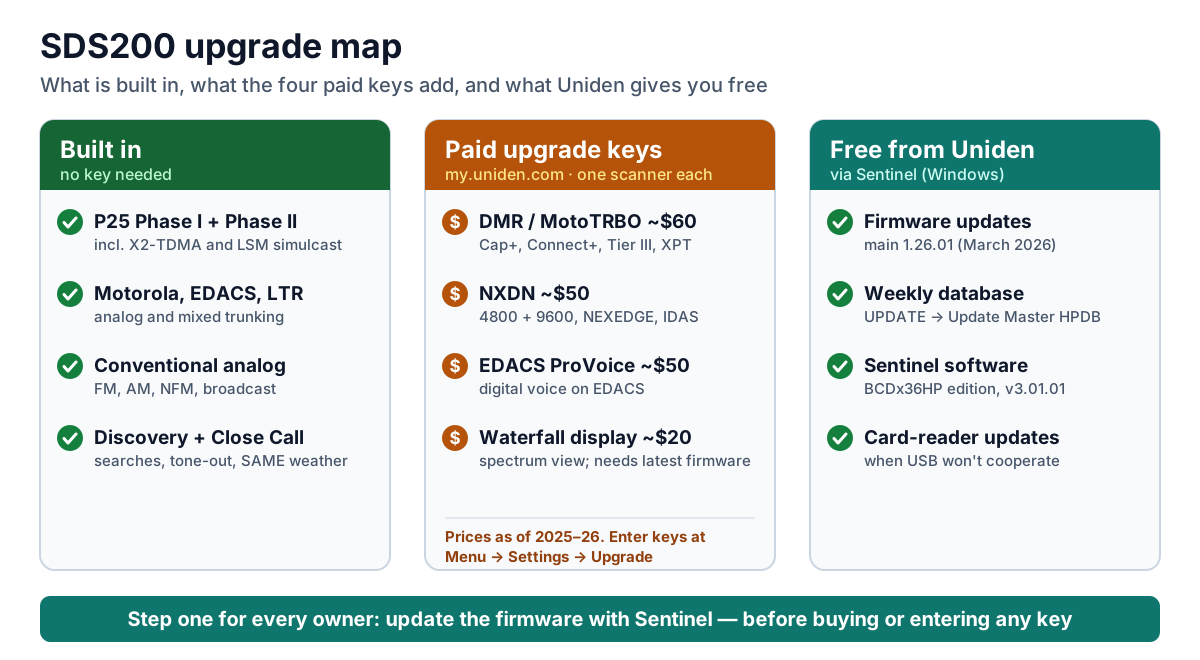
This volume answers the questions SDS200 owners ask most often. Does it decode P25 Phase II? What do the paid upgrades add, and which are worth buying? How is a key bought and entered? How is the firmware updated, and can the SD card or the front USB jack be used for it? The short answers:
- P25 Phase I and Phase II are built in, along with Motorola, EDACS, LTR, X2-TDMA, and conventional analog. No key is needed.
- Four optional paid upgrade keys add DMR (including MotoTRBO), NXDN, EDACS ProVoice, and the Waterfall spectrum display. Each key is tied to one scanner and entered on the radio.
- Firmware and the weekly database are free. Uniden delivers both through its free Windows program Sentinel, over the USB cable or with the microSD card in a card reader. The front USB-A jack and the network port do not update firmware.
- Update the firmware before anything else. Newer features, fixes, and some upgrade keys depend on it.
For day-to-day programming with Sentinel and ProScan, see Vol 3 — Programming.
5.2 Start here: update the firmware first
If you do only one thing, update the firmware and the database. Plenty of SDS200s in use still run the firmware they came with, especially units installed in a shack or a vehicle and never touched again. They are missing years of free improvements, and their database no longer matches the radio systems around them. Updating is free, takes about fifteen minutes, and is the first thing to do with any used or long-idle scanner.
Here is a sample of what free firmware has added since the SDS200 began shipping in 2019, per Uniden’s change log:
- RF filter options for strong-signal areas, an amplifier-off timer to stop hum between transmissions, and better DMR and NXDN reception (2019)
- Finer search steps (2022)
- Support for the Waterfall spectrum display (the display itself is a paid key), digital decoding improvements, and a keypad lock mode (December 2023)
- Weather alert (EAS) event codes, and support for DMR Tier III and Motorola Capacity Max systems (2025)
- Squelch improvements for broadcast FM (2025)
- Fixes for P25 control channels and P25 Phase II voice handling, and Capacity Max late entry (late 2025 to 2026)
As of September 2026 the current release is main firmware 1.26.01 (March 27, 2026) with sub-processor firmware 1.03.15. Uniden’s SDS200 firmware change log lists every release.
To check what your radio is running, go to Menu → Settings → See Scanner Information → Firmware Version. The same screen shows the scanner’s electronic serial number (ESN), which you need when buying an upgrade key.
The database goes stale fast. Uniden rebuilds the scanner’s radio database from RadioReference data every week. Agencies change frequencies, add talkgroups, and migrate systems constantly. An old database can make the scanner look broken when it is simply listening in the wrong places. Update the database every few weeks, and check for firmware at the same time.
5.3 What’s built in and what’s a paid upgrade
Table 1 — What's built in and what's a paid upgrade
| Capability | Status on a US SDS200 | Typical use | Price (my.uniden.com, as of 2025–26) |
|---|---|---|---|
| Conventional analog (FM, AM, NFM, broadcast) | Built in | Everything analog | Included |
| P25 Phase I and Phase II, including X2-TDMA, simulcast (LSM), and one-frequency trunking | Built in | Most US public-safety systems | Included |
| Motorola, EDACS, and LTR trunking | Built in | Older trunked systems | Included |
| Discovery, Close Call, custom searches, tone-out, SAME weather | Built in | Finding signals and alerts | Included |
| DMR / MotoTRBO (Capacity Plus, Connect Plus, DMR Tier III, Hytera XPT, single-channel DMR) | Paid key | Business, utility, school, and some government systems | About $60 |
| NXDN (both 4800 and 9600; NEXEDGE and IDAS) | Paid key | Utilities, railroads, business fleets | About $50 |
| EDACS ProVoice | Paid key | Digital voice on some EDACS systems | About $50 |
| Waterfall display | Paid key | Seeing activity across a span of spectrum | About $20 |
The prices come from receipts owners have posted, because Uniden’s store requires a login; check my.uniden.com for current pricing. Dealers charge more for the same keys.
5.3.1 Choosing upgrades
Only buy a key for systems you actually want to hear:
- Look up your county on RadioReference and open the trunked systems and frequency listings you care about.
- Check each system’s type or mode and match it to a key:
- DMR, MotoTRBO, Capacity Plus, Connect Plus, Capacity Max, or Hytera XPT need the DMR key.
- NXDN, NEXEDGE, or IDAS need the NXDN key.
- EDACS with ProVoice needs the ProVoice key.
- Project 25 (Phase I or II) needs nothing.
- The Waterfall key is for exploring. It draws a live graph of signals across a band so you can spot activity and jump to it. It does not decode anything new, and the SDS200’s larger display suits it well.
A key unlocks a decoder that is already in the firmware; it does not change the hardware.
5.3.2 Common myths
Table 2 — Common myths
| You may have heard… | The facts |
|---|---|
| ”P25 Phase II is an extra-cost upgrade.” | No. Phase I and Phase II are standard on every SDS200. |
| ”Waterfall is a free firmware feature.” | Firmware added support for it, but the Waterfall display itself needs a paid key. |
| ”You can install an upgrade key through Sentinel.” | No. Keys are entered on the scanner, under Menu → Settings → Upgrade. |
| ”A factory reset or a new SD card erases my keys.” | Keys are stored in the scanner’s internal memory, not on the card. They normally survive firmware updates, resets, and card changes. |
| ”The front USB-A jack updates firmware from a thumb drive.” | No. Uniden reserved that jack for future expansion. Firmware comes only through Sentinel, over USB or with the card in a card reader. |
| ”The network (LAN) port can update firmware.” | No. The LAN port is for ProScan control, audio streaming, and the built-in FTP server. |
| ”The database needs a RadioReference subscription.” | No. Uniden’s weekly database is free. RadioReference Premium is only needed for ProScan’s direct RadioReference import. |
| ”The SDS200 has built-in GPS.” | No. It accepts an external GPS receiver on its rear GPS jack. |
5.4 What the SDS200 can’t hear
With all its keys installed, the SDS200 decodes essentially all unencrypted US public-safety voice. Some voice stays silent, though.
Silent until you buy the key (see the table above):
- DMR / MotoTRBO: common on school, utility, business, and some county and fire systems.
- NXDN: used by some utilities, railroads, and county systems.
- EDACS ProVoice: found on a few older state and county EDACS systems.
Silent no matter which keys you buy:
- Encrypted voice of any kind. This includes P25 Phase I and II, DMR, NXDN, and ProVoice, whether the encryption is AES, DES, or Motorola ADP. The scanner mutes it, and decrypting it would be illegal. You’ll run into this more than anything else on this list: many agencies encrypt tactical, investigative, and sometimes all dispatch talkgroups.
- OpenSky (M/A-COM/Harris). OpenSky uses a proprietary, non-public protocol with no control channel, and no scanner has ever been able to monitor it. Pennsylvania’s statewide network used OpenSky until 2022.
- TETRA. It isn’t used for US public safety, and no Uniden scanner decodes it.
- Analog voice scrambling, such as voice inversion or rolling-code scramblers.
- dPMR. Uniden sells it only for European models like the SDS200E.
- Push-to-talk over cellular (LTE), including FirstNet push-to-talk apps, Motorola WAVE, and Harris BeOn. This traffic travels as cellular data, not as radio voice a scanner can receive.
- Anything outside the SDS200’s frequency coverage. It tunes 25–512, 758–824, 849–869, 894–960, and 1240–1300 MHz. The cellular bands are blocked by law, and nothing above 1300 MHz is covered, including the 4.9 GHz public-safety band, which carries mostly data anyway.
How to check your area. Look up each system you care about on RadioReference:
- Project 25, Motorola analog, EDACS, or LTR: the SDS200 hears it with no key.
- DMR, NXDN, or ProVoice: you need that key.
- Encrypted talkgroups (a mode ending in E, such as DE or TE) or an OpenSky system: no scanner will help.
Older “unscannable” lists sometimes still include EDACS ProVoice. That’s out of date, because Uniden sells a ProVoice key for this scanner.
5.5 Buying and entering an upgrade key
- Update the firmware first (next section). Uniden’s Waterfall instructions require the latest firmware, and current firmware avoids surprises with the other keys too.
- Find the scanner’s ESN. Go to Menu → Settings → See Scanner Information → Firmware Version. Write down the electronic serial number and the short checksum shown with it, and copy them carefully: the key is generated for that exact radio.
- Buy the key. Register the scanner at my.uniden.com, open it from your list of devices, and use the upgrade link for the feature you want. The key appears in your account and is emailed to you. Allow up to a few days.
- Enter the key on the scanner.
- Go to Menu → Settings → Upgrade and choose Upgrade DMR/MotoTRBO, Upgrade NXDN, Upgrade ProVoice, or Upgrade Waterfall.
- Enter the entire key, including the dashes. Turn the scroll knob to pick each character, and use the arrow soft key to move to the next one.
- Don’t press E until the last character is entered. Once the key is accepted, the feature is available immediately.
Before you buy, know that:
- Keys are tied to one scanner. They can’t be moved to another radio and are not refundable once issued.
- You should keep your my.uniden.com account and the emails. Keys normally survive firmware updates, resets, and card changes. If one ever needs re-entering, you can retrieve it from your account.
- European models are different. The SDS200E ships with DMR and NXDN already active. E owners buy any other keys from Uniden Australia (scanner.uniden.com.au), which also offers a dPMR upgrade. US keys don’t work on E models.
5.6 How to update: Sentinel over USB
This is Uniden’s documented method and the one to try first.
What you need
- A Windows 10 or 11 PC with an internet connection. Sentinel is Windows-only, downloads firmware and the database while it runs, and sometimes needs Run as administrator.
- Sentinel, free from the SDS200 download page (current version: Sentinel 3.01.01, zip). Unzip it and run setup.exe.
- Uniden names this edition “BCDx36HP Sentinel”, and it is the correct program for the SDS200 and SDS100.
- It is not the HomePatrol Sentinel.
- Uniden’s manual advises always using the latest version.
- The supplied USB cable, plugged into the mini-USB port on the scanner’s front panel. The rear micro-USB and the USB-A jack are not used for updates.
- External power. The SDS200 has no battery, so make sure its power supply stays connected for the whole update.
Update the firmware
- Turn the scanner on and connect the USB cable to the PC.
- When the scanner asks for a USB mode, press E/yes to select Mass Storage.
- Start Sentinel, select UPDATE → Update Firmware, and follow the prompts. Sentinel checks Uniden’s server and writes the latest main and sub-processor firmware to the scanner’s card.
- When Sentinel finishes, turn the scanner off before unplugging the cable so it can finish writing to the card.
- Turn the scanner back on and let it apply the update without interruption.
- Confirm the new version under Menu → Settings → See Scanner Information → Firmware Version.
Update the database
- Reconnect in Mass Storage mode.
- In Sentinel, select UPDATE → Update Master HPDB. This only updates the database inside Sentinel.
- Select Scanner → Write to Scanner to copy it to the SDS200.
- Turn the scanner off, unplug the cable, and power up.
Before big changes, back up the card. A copy of the microSD card is a complete backup of the scanner’s configuration (Vol 3 — Codeplug backups).
5.7 Alternative: update the microSD card in a card reader
The SDS200 keeps everything on its microSD card: Favorites Lists, settings, the database, recordings, and firmware update files. That means Sentinel can do the same work with the card in an ordinary PC card reader, treating the card as though it were the scanner. Use this method when:
- the USB connection won’t work, is slow, or keeps failing;
- the scanner is installed somewhere a PC can’t easily reach, such as a vehicle dash.
Steps
- Turn the scanner off. The card slot is spring-loaded: push the card in with a fingernail until it springs out. Owners report these slots wear with heavy use, so be gentle.
- Put the card in a microSD card reader (or an SD adapter in a standard reader) on the Windows PC.
- Start Sentinel. If the card doesn’t appear, tick Display all drives.
- Run UPDATE → Update Firmware, then UPDATE → Update Master HPDB and Scanner → Write to Scanner, just as you would over USB.
- Eject the card safely in Windows and push it back into the scanner until it latches.
- Power the scanner on and let it finish applying any update.
Rebuilding a corrupted card
If the scanner reports card errors or won’t start properly:
- Back up whatever you can first: copy the card’s files and save your Favorites Lists in Sentinel.
- Format the card with the SD Association’s free SD Memory Card Formatter. Uniden supports cards up to 32 GB.
- If the now-empty drive doesn’t show up, Windows may be hiding it: turn off Hide empty drives in File Explorer’s options.
- In Sentinel, run Clear User Data on the card (tick Display all drives). This recreates the scanner’s files and folders.
- Run Update Firmware, update the database, and use Scanner → Write to Scanner to restore your Favorites Lists.
Formatting erases everything on the card, recordings included. Upgrade keys are not affected, because they live inside the scanner.
5.8 The network port, ProScan, and updates
The SDS200’s Ethernet (LAN) port is set up under Menu → Settings → LAN Settings, using either DHCP or a manual IP address. The scanner restarts after you change these settings. The same menu can turn on a built-in FTP server with read-only and writable accounts. Over the network, ProScan can control the radio, stream its audio, and feed Broadcastify, which is the SDS200’s big advantage over the SDS100.
Neither the network port nor ProScan updates firmware or installs upgrade keys. ProScan (version 24.13, September 2026) is a $50 lifetime license for two PCs with a 30-day trial. Keep Sentinel installed for updates.
5.9 Downloads and manuals
Manuals in this site’s Reference Library:
Table 3 — Manuals in this site's Reference Library
| Document | Covers |
|---|---|
| Uniden SDS200 Owner’s Manual | Setup, operation, menus, Sentinel, firmware and database updates |
| Easier to Read SDS100/SDS200 Manual | A community-written, reorganized manual for both models, including the Upgrade, USB-mode, and LAN menus |
| SDS100/SDS200 Waterfall Feature Manual | Installing the Waterfall key and using the display |
All SDS200 documents in one list: Reference Library — SDS200.
Software and Uniden pages
- Uniden SDS200 download page: Sentinel and manuals
- Sentinel 3.01.01 (zip): direct download
- SDS200 firmware change log: what each firmware release changed
- my.uniden.com: register the scanner, buy and retrieve upgrade keys
- Uniden Australia scanner store: upgrade keys for E models
- SD Memory Card Formatter: rebuilding a card
- ProScan: third-party programming and network control software
- RadioReference: look up which systems your area uses
Sources
- Uniden America, SDS200 Owner’s Manual: firmware and database update procedures, USB modes, Upgrade and Scanner Information menus, included accessories, specifications.
- Uniden America, Waterfall Feature Operation Manual: buying and entering the Waterfall key.
- Uniden: SDS200 firmware change log, SDS200 download page, Uniden Australia scanner store.
- Easier to Read SDS100/SDS200 Digital Scanner Manual (updated November 30, 2024): USB mode prompt, Upgrade and LAN menus, card removal.
- RadioReference Wiki: SDS200, Sentinel for the BCD436HP/BCD536HP/SDS100/SDS200.
- RadioReference forums:
- RadioReference Wiki: OpenSky, Trunked Radio Systems; RadioReference forums: OpenSky scanners, TETRA.
- ProScan purchase information; RadioReference Premium.
Comments (0)