Uniden BCD536HP · Volume 2
Uniden BCD536HP — Vol 2: Operations
P25 Phase II, GPS, Wi-Fi remote control
2.1 Operating modes
The BCD536HP decodes everything the BCDx36HP firmware tree supports. This is the layer cake of modes — the table below distinguishes what’s universal vs. what’s a paid-option firmware extension. Cross-link Vol 13 §3 ↗ for the broader feature-comparison framing across the Uniden lineup (where the BCD536HP sits as “the generation before SDS200”).
Table 1 — Operating modes
| Mode | Supported? | Notes |
|---|---|---|
| Analog conventional FM (NFM / WFM) | Yes — standard | The bread and butter for ham, marine, aero, public-safety legacy. |
| Analog conventional AM | Yes — standard | Airband 108-137 MHz, some legacy services. |
| Motorola Type I / II / IIi (analog trunked) | Yes — standard | Legacy LMR backbone for many municipalities. |
| EDACS | Yes — standard | Legacy GE/Ericsson trunked. |
| LTR | Yes — standard | Logic Trunked Radio (small-business / utility). |
| P25 Phase I (FDMA) | Yes — standard | C4FM modulation, conventional and trunked. |
| P25 Phase II (TDMA) | Yes — standard | H-DQPSK modulation on the trunked control channel, two voice timeslots per RF channel. The dominant modern public-safety mode in the US. |
| P25 simulcast (LSM) | Yes — with limits | The BCD536HP decodes P25 simulcast, but the SDS series’ True I/Q receiver generally handles dense simulcast systems better. |
| DMR / MotoTRBO (conventional DMR, Capacity Plus, Connect Plus, Linked Capacity Plus, Tier III) | Yes — paid key (about $60; firmware 1.11.15 or later) | Business, utility, and amateur DMR over the air (for the DMR network side see Vol 2). The key is entered on the scanner, not in Sentinel — see Vol 5 — Upgrades & Firmware. |
| NXDN (trunking, one-frequency trunking, Icom IDAS) | Yes — paid key (about $50–60; firmware 1.14.00 or later) | Narrowband digital used by some utility and business systems. |
| Motorola Connect Plus | Yes — part of the paid DMR key | Motorola’s DMR-based trunking; common in commercial installations. |
| X2-TDMA | Yes — standard | Earlier Motorola TDMA flavor. |
| Hytera XPT, DMR Tier III | Yes — with the DMR key | Firmware refined XPT handling (2017) and added Tier III multi-block grants and Capacity Max late entry (2025). |
| ProVoice (EDACS ProVoice) | Yes — paid key (about $50; firmware 1.10.02 or later) | Digital voice on some EDACS systems. Some references list ProVoice as standard on this model; Uniden sells it as an upgrade. |
| TrueIQ baseband | No | Conventional heterodyne architecture, predates TrueIQ. Where TrueIQ matters: dense-RF urban environments with overlapping simulcast and adjacent-channel interference; for the typical suburban/rural monitoring case the BCD536HP’s selectivity is fine. |
| Encrypted P25 / DMR / Motorola | No (legally — decryption is illegal even with capability) | The BCD536HP cannot decrypt any encrypted system. This is correct: passive decryption is prohibited under federal law (18 USC §2511). Encrypted talkgroups show up as “ENC” on the display and produce no audio. |
The honest summary: with the keys it needs, the BCD536HP decodes everything the average operator will encounter. The gaps vs. the SDS200 ↗ (True I/Q receiver, the Waterfall display, Ethernet) matter in a minority of geographies and use cases.
2.2 Field use
Antenna pairing for the BCD536HP is mostly about posture. The two common deployments — base/desktop, and vehicle/mobile — call for different antennas.
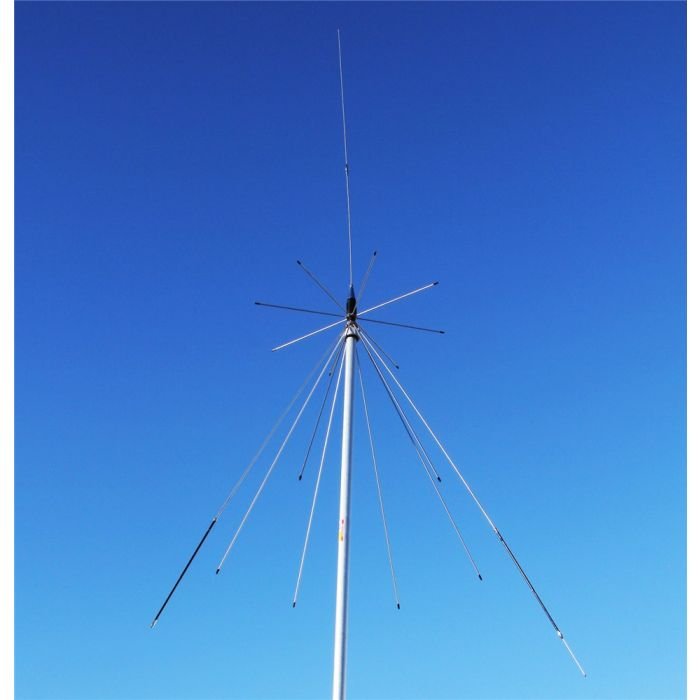
Base/desktop: outdoor discone is the right answer for general wideband scanning across the BCD536HP’s coverage (25-512 MHz, 758-960 MHz, 1240-1300 MHz with gaps). Diamond D-130J ($90, 25-1300 MHz, 18 elements, +0 dBi reference), Comet DS-150S ($110), or a budget Tram 1410 ($75) all fit the role. Roof-mount or attic-mount for line-of-sight to local public-safety repeaters; expect ~50-100 ft of LMR-400 feedline run with N or BNC terminations — see Antennas Vol 12 (Discone) for the geometry-by-frequency tradeoffs and Antennas Vol 5 (Transmission Lines) for the feedline loss calculations (a 100 ft LMR-400 run at 800 MHz costs ~3 dB — meaningful when chasing weak fringe-area public-safety signals).
If specific bands matter more than wideband coverage — e.g. a serious public-safety scan in the 700/800 MHz P25 band with no interest in HF/VHF utility traffic — a log-periodic (Antennas Vol 9) with narrower forward-arc gain (+5 to +7 dBi over the discone’s reference 0 dBi) buys 6-10 dB of receive margin on the bands of interest. Tradeoff: pattern directionality means signals off the back/sides are attenuated.
Vehicle: NMO mag-mount dual-band whip is the standard answer. Larsen NMO-150/450 ($60, 2 m + 70 cm), Comet CA-2x4SR ($55), or for wider scanner-band coverage the Diamond NR770HBNMO ($65) which is rated for the wider Uniden scan range. Mag-mount avoids drilling the roof; NMO permanent mount through the roof or trunk lip is mechanically superior but vehicle-specific.
For both deployments, cross-link Antennas Vol 29 (Use-case Matrix) which has the explicit per-radio antenna recommendations including the BCD536HP entry with the 4-tier upgrade ladder.
GPS-based location-aware scanning: with an external NMEA GPS receiver on the rear-panel DB-9 serial port (4800 bps default), the BCD536HP can automatically avoid and un-avoid systems, sites, and departments based on physical location. This is the right choice for vehicle use — driving from Cleveland to Pittsburgh, the scanner hands off from CECOMS (Cleveland Emergency Communications) sites to Allegheny County sites without manual reconfiguration. The setup: connect the GPS, set the serial-port baud rate under Set Up GPS, and enable location control; the database already carries site locations.
Recording: the Replay function holds up to 240 seconds of recent transmissions, and the Record function saves transmissions to recording sessions on the microSD card, reviewable on the radio or copied off in Mass Storage mode. For a PC recording or streaming pipeline, use ProScan over USB or Wi-Fi — the BCD536HP has no line-out jack.
Power supply hygiene: the bundled wall adapter is fine for desktop. For vehicle, fuse the 12 V feed at 1 A. Some vehicle 12 V rails are noisy on the audio output — a ferrite choke on the power feed plus a separate ground return (not chassis-grounded at the scanner) cures most of it.
Comments (0)